
Table of Contents
Navigating ABA CPT Codes 2026 in Missouri and Illinois
The aba cpt codes 2026 that guide ABA billing are the same across state lines, so families in Missouri and Illinois rely on the same code families. At the core are adaptive behavior treatment codes: assessment code 97151 and treatment-by-protocol codes such as 97153 (the exact aba cpt codes 2026 should always be confirmed against your insurer’s current fee schedule). Three common aba billing modifiers — 95 (telehealth), 96 (habilitative), and 97 (rehabilitative) — affect reimbursement, and 2026’s telehealth expansion makes modifier 95 especially relevant. As our 2026 ABA trends guide explains, telehealth and AI-assisted documentation are shaping how ABA codes are tracked and billed.
Coverage varies by plan, and prior authorization may be required before treatment begins. The next step is asking: does insurance cover ABA therapy? Our team will verify your plan so you can move forward with a personalized therapy plan that fits your child’s needs.
Preparing for ABA CPT Code Success
As we step into the ABA CPT codes 2026 update cycle, it helps to know which adaptive behavior treatment codes define ABA assessment and ongoing therapy. These codes form the foundation your claims will reference, and our team at HeartCore ABA works alongside you so every detail is in place before your child’s first session.
Getting claims processed smoothly often comes down to ABA billing modifiers — the small code additions that signal who delivered the service, where it happened, and other key details. We’ve seen that accurate modifiers turn a complex claim into a clean submission. Here’s how we help you prepare:
- You share your insurance or Medicaid details, and we verify your benefits upfront.
- We check whether prior authorization is needed and coordinate that step with your plan.
- Before therapy starts, a Board Certified Behavior Analyst (BCBA) completes a thorough assessment and creates a personalized therapy plan, then we match your child with a consistent clinician.
This approach applies whether therapy happens in your home, school, or a center in Springfield, Missouri, in St. Louis, in Kansas City, in Columbia, or in Chesterfield, Virginia. Please verify your own plan details; results may vary, and this information is not a substitute for professional medical advice. HeartCore’s insurance verification is hands-on support — not a guarantee. Contact us, and we’ll walk you through the next steps — because your child deserves care that comes straight from the heart.
Identify the Right ABA CPT Codes for Your Child’s Sessions
ABA CPT codes 2026 don’t have to feel overwhelming — here’s what they mean for your child’s sessions. ABA therapy covered by insurance is the most common question we hear from parents, and getting the right CPT code is the first step to answering it.
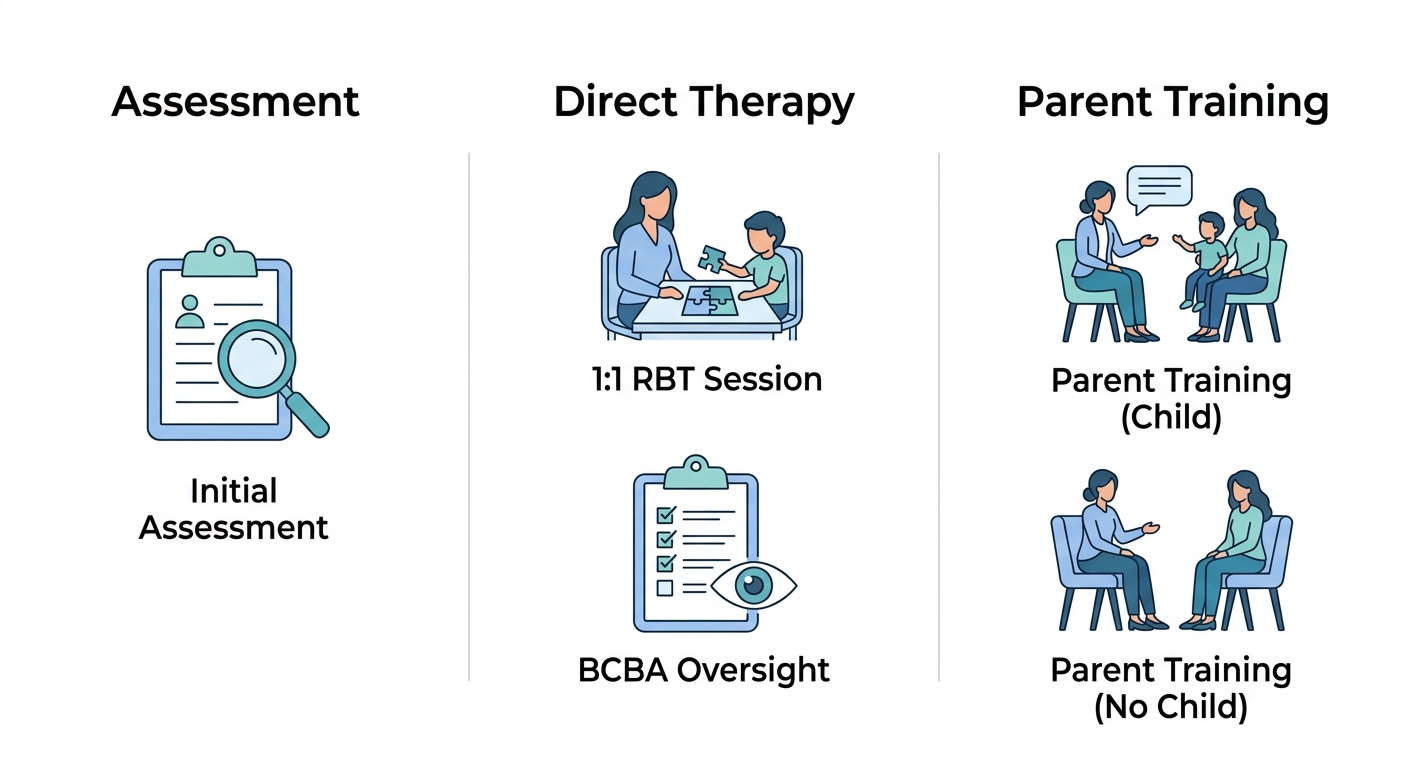
The 2026 adaptive behavior treatment codes cover assessment, therapy, supervision, and training:
- 97151 – BCBA initial assessment
- 97153 – 1:1 therapy with an RBT (in-home, school, or center sessions)
- 97155 – BCBA supervision and plan modification
- 97156/97157 – Caregiver training with and without the child present
- 97158 – Group treatment
Because BCBAs design and supervise while RBTs deliver direct care, the codes reflect that difference. ABA billing modifiers like -95 (telehealth) and -59 (distinct services) add context, not a new code.
Ask who provided the service, whether your child was present, and the setting — that usually points to the right code. If you need help, call us for a benefits check; every plan is different and prior authorization may be required, and we can’t guarantee coverage.
Gather Necessary Insurance Documentation
Sorting through insurance details can feel overwhelming when you’re eager to start ABA therapy, but gathering a few key documents now makes the verification process fast and stress-free. Here’s what to have ready:
- Your insurance member ID card — front and back
- Policyholder name and date of birth
- Group or policy number
- BIN, PCN, and RX Group numbers (if they appear on your card)
- Claims mailing address and customer service phone number
- Any referral, prescription, or prior authorization paperwork for ABA therapy
Our Heart Core ABA team takes care of the full benefits verification for you — you won’t have to call your insurance alone. We’ll confirm deductibles, copays, and session limits before any services begin, and we’ll let you know if prior authorization is needed. Families insured through Medicaid may need to submit additional paperwork, and our team can help you understand what’s required. Please remember that coverage must be verified and may require prior authorization, and this page does not replace professional medical advice.
With ABA CPT codes 2026 updates now in effect, understanding your child’s Explanation of Benefits is more important than ever. An EOB is a summary from your insurance company — not a bill — that shows how claims for ABA therapy were processed.
On the EOB you will see member details, the claim number, date of service, and provider information for Heart Core ABA. Key columns include Amount Billed, Allowed Amount, Insurance Paid, and Patient Responsibility. Deductible amounts applied toward your plan will also appear here.
ABA therapy is billed using adaptive behavior treatment codes such as 97153 (technician-delivered treatment) and 97155 (BCBA protocol modification). ABA billing modifiers like -HM, -HN, -TG, and -U6 indicate the setting or provider type. The Units column reflects 15-minute increments — for example, 4 units equal one hour of service. If something looks off, do not pay yet — check the date, modifier, or code and reach out to us first.
If you are wondering whether your Medicaid plan will cover these services, see our guide on whether does medicaid cover ABA therapy — and if you have questions about your EOB, we are here to help. Prior authorization may be required; this information is not a substitute for professional medical advice, and results may vary. Contact our team in Springfield, MO, and we will review your statement together.
Understanding BCBA-Led Parent Training Codes
Understanding aba cpt codes 2026 gives families clarity on how BCBA-led parent training is structured and billed. These distinct CPT codes ensure that a Board Certified Behavior Analyst (BCBA) directly trains caregivers, not an RBT, in evidence-based techniques to support their child’s progress at home.
The primary codes are CPT 97156 for individual family caregiver training by a BCBA, and CPT 97157 for group caregiver training, with optional CPT 97158 for multiple-patient groups. Because these services fall under adaptive behavior treatment codes, they must be delivered under active BCBA supervision; they cannot be delegated to a Registered Behavior Technician. Insurance plans may also apply aba billing modifiers, such as modifier GT for telehealth, which we verify during prior authorization checks.
We rely on the Behavior Analyst Certification Board (BACB) for code definitions and on CMS Medicaid guidelines for billing requirements. We always remind families to verify insurance coverage; prior authorization may be required. Real progress, real connection starts with clear understanding.
Missouri Medicaid vs. Private Insurance: Key Billing Differences
When reviewing ABA CPT codes 2026, families see billing differences between coverage in Missouri Medicaid and with private insurers. In Missouri Medicaid, providers must enroll and obtain client-specific prior authorization before starting services; with private insurers, retroactive authorization for initial sessions is often permitted. Our team checks current policies through the medicaid and CHIP program portal.
For claims, in Missouri Medicaid modifiers TF (primary caretaker) and TG (complex delivery) are typical, while with private plans, HA (child/adolescent) and HN (bachelors level) are common for 1:1 therapy codes. Using accurate aba billing modifiers and adaptive behavior treatment codes prevents denials.
Reimbursement in Missouri Medicaid is fixed per unit and generally lower than negotiated rates with private insurers. Missouri Medicaid may cap annual hours, while with private plans, visit limits and deductibles often reset each benefit year.
We remind families to verify their own coverage and that prior authorization may be required. Next, we’ll break down the specific 2026 CPT codes to simplify billing.
Using CPT 97153 for Direct Technician Services
When reviewing aba cpt codes 2026, CPT 97153 is the code for direct technician services. Defined as adaptive behavior treatment by protocol, it is delivered by an RBT under BCBA supervision according to BACB standards. As one of several adaptive behavior treatment codes, it covers one-to-one therapy in home, school, or center settings.
This time-based code is billed in 15-minute units. Common aba billing modifiers like GT (telehealth) or HA (child/adolescent) may apply, but you must verify with your plan. Medicaid may cover CPT 97153, often requiring prior authorization, daily notes, and BCBA supervision logs per CMS guidelines.
Our Springfield, MO team delivers hands-on ABA therapy for children who learn differently, with consistent therapist matches and weekly parent updates ensuring real progress.
Results may vary. Consult a healthcare professional for diagnosis and treatment. Verify insurance coverage and prior authorization requirements. With CPT 97153 defined, the next section reviews additional adaptive behavior treatment codes that complete the aba billing picture.
Submit Your ABA Claims and Track Reimbursement
Once your benefits are verified, we take care of the next step—submitting your claims. Verify insurance coverage and that prior authorization may be required. We handle the entire process using the correct ABA CPT codes 2026 standards to streamline reimbursement.
Step 1: Free Insurance Verification. We start with a complimentary call to check your coverage and benefits—have your insurance member ID and group number ready. After that, we handle the entire claim submission process, including obtaining prior authorizations when necessary. Our team works with both private insurance and Medicaid, filing claims electronically to minimize delays. Throughout the process, you’ll receive weekly parent updates that include the status of submitted claims and reimbursement progress. We apply proper aba billing modifiers and adaptive behavior treatment codes to ensure accurate reimbursement. Reimbursement timelines vary by insurer, but we keep you informed with regular updates on expected dates.
If you’re in Springfield, MO or any of our service areas, contact us today to start your claim process and let us handle the paperwork with care that comes straight from the heart.
Resolving Common ABA Billing Challenges
Even with insurance in place, billing hiccups can feel stressful. But here is the good news: most denials come from a few predictable errors, and we at Heart Core ABA have the team and tools to walk your family through each one. Understanding how to use the aba cpt codes 2026 correctly is a powerful first step.
Three obstacles cause the majority of claim rejections. First, submitting outdated billing codes. In 2026, payers require the current adaptive behavior treatment codes – specifically 97151 through 97158, plus the add-on codes 0362T and 0373T – to match the service provided. When our team verifies your benefits, we confirm which codes your plan expects, which dramatically reduces denials. Second, missing or incorrect aba billing modifiers. A telehealth parent-coaching session typically needs the GT modifier, while direct therapy delivered by a technician holding a bachelor’s degree requires the HN modifier; supervision by a master’s-level BCBA uses HO, and modifier 59 signals a distinct procedure performed on the same day. Applying the right modifier takes only a moment but keeps a claim from stalling in review. Third, gaps in prior authorization or documentation. Our insurance specialists contact your plan before your child’s first visit to secure the required authorizations, so most billing friction never reaches your mailbox.
If a denial does occur, resolve it with a simple three-step process: identify the reason code on the explanation of benefits, correct the error, and resubmit with the missing documentation. Our billing team handles these appeals on your behalf, often using AI-assisted tools that auto-select codes and check modifiers, which helps prevent repeat mistakes.
Coverage and prior authorization requirements vary by plan; verify with your insurance provider. Once billing is cleared, the next step is scheduling your child’s first session with their dedicated BCBA.
Moving Forward with Confidence in ABA Billing
Staying current with ABA CPT codes 2026 and correctly applying ABA billing modifiers is essential for reducing denials and accelerating payments. By mastering these current codes and modifiers, you can submit claims with greater accuracy and see faster reimbursements. This proactive approach builds a confident, streamlined billing process that keeps your practice running smoothly.
Heartcore ABA’s recent analysis of 2026 trends reveals that AI and telehealth are reshaping billing workflows, particularly in how adaptive behavior treatment codes are documented. This technology supports accurate documentation, making it easier to stay compliant and efficient while freeing up your team to focus on clinical care.
Heartcore ABA’s teams adhere to BACB certification standards, ensuring every billing decision meets ethical guidelines. We are here to help you navigate every step—from insurance verification to denial management—so you can focus on delivering meaningful therapy. With our insurance navigation support, you can approach each claim with confidence. While many providers see improved payment timelines, results may vary.