Table of Contents
Understanding Positive Reinforcement Techniques in ABA Therapy
Positive reinforcement techniques are central to our approach at Heart Core ABA. We add a rewarding stimulus right after a desired behavior, making it more likely to happen again.
For instance, we might offer praise or a favorite toy after a child follows a direction. According to the Centers for Disease Control and Prevention, positive reinforcement is a proven behavioral strategy. We use play-based, personalized positive reinforcement techniques to build real progress and real connection. This is woven into our behavior management strategies and aba parent training strategies to help families maintain consistency at home. Results may vary and are not guaranteed.
Now that you understand positive reinforcement techniques, see how we apply these techniques in your child’s personalized therapy plan.
1. Master the Most Effective Techniques
At Heart Core ABA, our hands-on ABA therapy for children who learn differently starts with positive reinforcement techniques that turn everyday moments into growth. When a child completes a task like putting on shoes, we respond with genuine praise and high-fives, celebrating the effort and strengthening the skill. This joyful, play-based approach builds confidence and connection from the very first session.
Beyond praise, we use evidence-based methods like differential reinforcement of alternative behavior, which teaches a child to replace an unwanted action with a positive alternative, and token economy systems, where children earn tokens for desired behaviors that they can exchange for rewards. These behavior management strategies are woven into every session, and through our ABA parent training strategies, we empower caregivers to use the same techniques at home.
Our BCBAs hold the BACB behavior analyst certification and design every therapy plan. We coach parents to transfer these skills home. Results may vary, but these techniques drive every plan we build, whether at home, school, or center.
2. Create a Reward System That Works
Let’s build a reward system rooted in positive reinforcement techniques that works in your daily routine. At HeartCore ABA, our hands-on ABA therapy for children who learn differently turns everyday moments into learning opportunities.
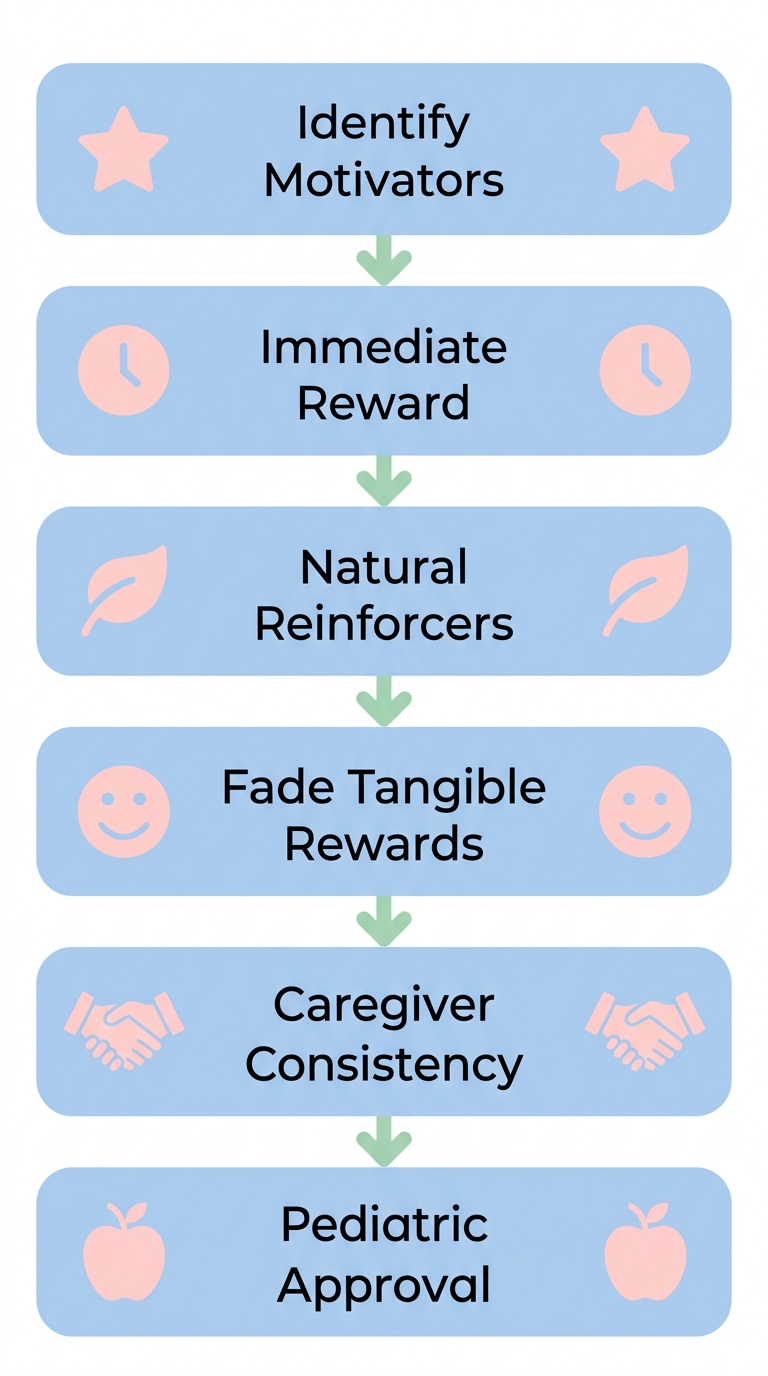
Six-step reward system infographic for ABA parent training and consistency.
As part of aba parent training strategies, we suggest picking a favorite toy, sound, or sensory break as a reward and delivering it right after the behavior you want to see. When possible, connect the reward to the activity—like letting a child play with puzzle pieces after completing the puzzle—just as we do in natural environment teaching. Over time, fade tangible rewards by swapping them for high-fives and enthusiastic praise. Consistency across caregivers is essential—everyone should use the same words and criteria. If you consider food rewards, always check with your pediatrician first; this information is not a substitute for professional medical advice. Once your reward system becomes part of your routine, these behavior management strategies become a powerful tool in your parent coaching journey, leading to real progress and connection.
3. Reinforcement vs. Bribery: Key Differences
Positive reinforcement techniques in ABA therapy are proactive, planned strategies that increase desired behaviors by delivering a reward after the behavior occurs. For example, a parent praises a child for picking up toys to encourage future clean-ups. Bribery, in contrast, is reactive—offering a treat to stop a tantrum in progress. The key difference is timing: reinforcement happens before or after the target behavior, while bribery happens during an undesired behavior.
Through aba parent training strategies, we coach caregivers to replace bribery with systematic reinforcement, a cornerstone of our behavior management strategies. Instead of bargaining during a meltdown at the grocery store, a parent can wait for calm and then reward that calmness with a small treat or praise. According to HeartCore ABA’s natural environment teaching approach, planned reinforcement builds lasting skills and avoids accidentally rewarding problem behavior. Our hands-on ABA therapy for children who learn differently relies on reinforcement, never on bribery, because understanding this difference is the first step toward using effective positive reinforcement techniques that help children thrive naturally.
4. Boost Communication with Positive Reinforcement
Now that you have some foundational tools in place, let’s focus on how positive reinforcement techniques can directly boost your child’s communication.
At HeartCore ABA, our aba parent training strategies turn everyday moments into learning opportunities. By using positive reinforcement techniques—like immediate praise or a favorite toy—you honor every communication attempt. Using natural environment teaching ABA, you can weave reinforcement seamlessly into play, meals, and bath time. For families in Springfield and across Missouri, a few simple techniques help:
- Use a “first-then” board to link a request with a reward
- Offer choices during meals to encourage speech
- Narrate actions with enthusiastic praise
- Reinforce every attempt right away, then gradually shape longer exchanges
We’ve seen these simple tools boost confidence and spark more frequent communication. Our parent coaching teams in Springfield love showing families how to use these techniques during daily routines. Consistency is vital: initially, reinforce every communication attempt you see, then gradually shape for more complex requests as your child’s skills grow. Over time, your child learns that speaking up leads to positive outcomes, and you’ll see real progress. These behavior management strategies, combined with positive reinforcement, create a supportive environment where communication flourishes.
Remember, results may vary, and this information is not a substitute for professional medical advice. Consult a healthcare professional for diagnosis and treatment.
5. Find the Right Frequency for Rewards
Once you’ve chosen rewards, deciding how often to deliver them is key—positive reinforcement techniques in ABA therapy guide this step. We tailor reward timing to each child’s unique needs.
- Reinforcement schedule: For new behaviors, we reward every correct response. As mastery builds, we shift to intermittent schedules—like a 1:3 or 1:5 ratio.
- Age and readiness: We recommend a 1:5 ratio for younger children, stretching to 1:10 as they progress.
- Tracking made simple: We encourage a simple log to track correct responses and rewards—an aba parent training strategy that prevents over-rewarding.
- Data-driven shifts: Data guides us: shorten the interval when progress stalls, lengthen it when strong. HeartCore ABA’s approach, including school-based consistency, aligns with broader behavior management strategies.
- Keep rewards fresh: If a reward loses appeal, rotate choices or adjust frequency to prevent satiation and keep motivation high.
With the right frequency, you’re ready to set up a reward system that stays motivating long-term. That’s where real progress, real connection begins.
When parents learn positive reinforcement techniques, they help children generalize skills from therapy into everyday life. Heart Core ABA’s parent training gives you practical aba parent training strategies that make reinforcement consistent across home, school, and community.
Use specific, immediate praise or token systems after desired behaviors—a form of positive reinforcement techniques that strengthens communication and cooperation. We also guide you in creating structured daily routines that mirror therapy sessions. Predictable schedules with visual supports and consistent language reduce anxiety and set clear expectations. Proactive behavior management strategies like offering choices or using if-then statements empower you to guide your child calmly during difficult moments.
A simple data chart helps you track progress and share insights with your BCBA. To avoid confusion, use the same rewards and phrasing as your child’s therapy team. Our parent coaching is an integral part of Heart Core ABA’s services, available in-home, in-school, or center-based. We customize each family’s training to fit their personalized therapy plan, so every session builds toward meaningful goals.
Reach out today to discover how our parent training can support your child’s growth—real progress, real connection, from our heart to yours.
7. Integrate Reinforcement with Behavior Management
Building on the behavior management strategies discussed above, we explore how to integrate positive reinforcement techniques with Natural environment teaching ABA in everyday moments.
We teach parents to weave reinforcement into routines like mealtime, dressing, or playtime—catching your child being good. For example, when your child follows a request during a preferred activity, you can praise them and let them continue the activity as a natural reward. Reinforcement serves two purposes: building new skills, such as learning words, and reducing challenging behaviors, like tantrums. Both can occur within the same natural environment teaching session.
In our BCBA-supervised programs, aba parent training strategies guide you to pair reinforcement with clear instructions and gentle redirection. We help you fade artificial reinforcers (like stickers) toward natural ones (like extra playtime) so skills stick. Results may vary; always consult your BCBA for a personalized plan, and a healthcare professional for diagnosis and treatment.
Next, we’ll explore tracking progress and fine-tuning your approach to sustain real progress and real connection.
8. Celebrate Small Wins Every Day
Beyond everyday routines, it’s just as important to pause and celebrate the small steps your child takes each day. Effective behavior management strategies include recognizing tiny wins—like making eye contact when called or trying a new word—that fuel motivation and deepen the parent-child connection.
When your child makes eye contact, celebrate instantly with a high-five or a favorite song. If they use a new word during snack time, respond with a big smile and an extra cracker. In our Natural Environment Teaching (NET) approach, we weave these positive reinforcement techniques into everyday moments; the celebration feels natural and motivates your child without overstimulation. Keep celebrations brief and connected to the activity, so the reinforcement stays meaningful.
These daily celebrations form the core of our aba parent training strategies. In Parent Coaching, we teach families to weave small victories into everyday routines, reducing the need for redirection. These daily celebrations lay the foundation for lasting progress and a stronger parent-child bond.
Start Using Positive Reinforcement Techniques Today
Now that you understand the why, here’s how to begin. We use positive reinforcement techniques to increase desired behaviors by immediately rewarding them with something the child enjoys. This can help build positive habits and is central to our play-based therapy.
Try immediate verbal praise and a high-five for following directions, or a token board where stickers earn a preferred activity. For example, natural environment teaching ABA uses everyday activities to deliver immediate positive reinforcement. Our parent coaching teaches you these aba parent training strategies, including simple positive reinforcement techniques you can start today.
Positive reinforcement is central to our behavior management strategies. In Springfield, our parent training program teaches these techniques with Real progress, real connection and care that comes straight from the heart.