Table of Contents
Natural Environment Teaching in ABA: Real Progress Through Everyday Play
One of the most natural ways we practice ABA is through natural environment teaching aba (NET) — a strategy that builds skills right where children live, learn, and play. Rather than sitting at a table, we weave learning into everyday moments at home, at school, or out in the community, so each interaction feels like play while still targeting meaningful goals.
During a bubble-blowing break, a child might request “more bubbles,” practicing communication in the very moment it matters most. Sorting toy cars by color turns into an opportunity to label colors and build vocabulary, all while the child enjoys a favorite activity. Board games naturally invite turn-taking, sharing, and social conversation. In NET, the reward is built into the activity itself — the reward is the natural result, like getting to keep playing or accessing a preferred toy, rather than an unrelated treat or token. This natural reinforcement helps skills stick because they feel genuine, not forced.
At Heart Core ABA, our BCBA-designed plans embed goals into each child’s unique interests and family routines, whether sessions happen in your home, at school, or in our center. Our RBT team delivers personalized 1:1 support that turns play into real progress, real connection — the kind of hands-on ABA therapy for children who learn differently that helps kids thrive in the places that matter most. While every child’s journey is unique, we see growth in communication and everyday skills; results may vary.
Understanding Natural Environment Teaching: The Foundation of Play-Based ABA
At Heart Core ABA, hands-on ABA therapy for children who learn differently means learning happens where life happens. Our care comes straight from the heart, built around Natural Environment Teaching (NET)—a naturalistic approach that turns everyday moments into powerful learning opportunities.
What Is Natural Environment Training in ABA Therapy?
Natural Environment Teaching (NET), sometimes called Natural Environment Training, is a core component of applied behavior analysis that embeds skill-building into a child’s everyday activities, play, and routines. Rather than pulling a child out of their natural setting for isolated drills, we use the child’s own interests and the places they already feel at ease—like the living room, playground, or classroom—to teach communication, social, and daily living skills. For example, if a child reaches for a favorite toy, our therapist will pause, model the word “toy,” and then hand it over as the reward. The child gets the toy they wanted; no token board or sticker is needed. This approach is grounded in the growing parent demand for natural environment teaching aba in therapy that feels less clinical and more like real life.
The Core Principles That Make NET Effective
Parents who research natural environment teaching aba often want to know what makes it effective. The answer lies in three core principles. First, child-led motivation: we follow your child’s lead, using what naturally captures their interest to teach new skills. Instead of a fixed script, a fascination with blocks becomes a chance to request and label. Second, natural reinforcers tie the reward directly to the action—saying “ball” and receiving the real ball feels far more rewarding than a sticker. Third, we embed learning into everyday routines like mealtimes or getting dressed, so skills are practiced where they’re actually used. That’s how children make real progress, real connection that lasts.
How NET Differs from a Traditional Table-Based Approach
A traditional table-based format often uses structured, adult-directed drills. A child might sit at a desk and complete repetitive tasks, earning tokens or edible treats for correct answers. While skills can be taught, the controlled setting often makes it harder for them to carry over to real life.
NET works the opposite way. Instead of pulling a child out of their natural environment, we bring learning to where they play, eat, and explore. The reward is the natural outcome—like receiving the toy they asked for or celebrating a new friendship skill. Because practice happens in real-life settings, skills generalize more easily. At Heart Core ABA, our BCBA-led teams deliver this naturalistic, play-based therapy 1:1 at home, school, or our center under a Personalized therapy plan. Results may vary; for diagnostic questions, consult a healthcare professional. We welcome your questions about how NET can fit your child’s unique path.
Discrete Trial Training vs. Natural Environment Teaching: Key Differences Explained
Two of the most common ABA teaching strategies are Discrete Trial Training (DTT) and Natural Environment Teaching (NET) — often searched for as natural environment teaching aba. While both are evidence-based and led by a Board Certified Behavior Analyst (BCBA), they look very different in everyday practice. Understanding these differences helps families feel confident about their child’s personalized therapy plan.
Side-by-Side: DTT vs. NET
To see how the two approaches differ in practice, we compare them across five key dimensions: the setting, who leads the instruction, how reinforcement is delivered, how generalization happens, and which skills each targets best.
| Dimension | Discrete Trial Training (DTT) | Natural Environment Teaching (NET) |
|---|---|---|
| Setting | Table or structured clinical area | Real-life settings: home, school, community, play |
| Instructional Lead | Therapist-directed with repeated trials | Child-motivated through natural play and routine |
| Reinforcement | Tokens, edibles, or praise after correct responses | Natural outcomes embedded in the activity itself |
| Generalization | Often requires separate practice across environments | Built into the learning context automatically |
| Best Suited For | Discrete skills like matching, imitation, or rote tasks | Communication, social, daily living, and play skills |
In short, DTT is structured and therapist-directed, while NET is child-motivated and happens in real-life settings. This table highlights why BCBAs often use both strategies within one personalized plan.
Finding the Right Balance: When Each Approach Works Best
Which method a therapist chooses depends on the skill being taught, the child’s learning style, and the goal of the session.
- DTT is often favored during early skill acquisition, when a child is learning new discrete responses (such as matching colors or imitating actions) and benefits from clear, repeated trials with immediate reinforcement.
- NET is typically more effective for generalization, social communication, and skills that need to be used flexibly across settings — like requesting a snack during snack time, taking turns on the playground, or following directions during a morning routine.
Most providers blend DTT and NET because the two methods complement each other. DTT builds the foundation, while NET ensures the skill is used naturally and meaningfully in everyday life.
How BCBAs Blend Structured and Naturalistic Teaching
A board-certified behavior analyst designs a treatment plan that matches the right teaching strategy to each skill. For example, a BCBA might begin with DTT sessions to teach a child to identify pictures, then shift to NET-style play to practice those labels during a tea party or while building blocks. This blending happens throughout the week, always guided by the child’s progress and motivation.
At Heart Core ABA, our BCBA-led team creates a personalized therapy plan that weaves together structured and naturalistic teaching. Whether we’re working one-on-one at a table, following the child’s lead during play, or supporting a classroom routine, the goal is the same: real progress and real connection in the moments that matter most. We use DTT for precision skill-building and NET for functional, joyful practice — and our BCBAs adjust the balance as the child grows.
While we are proud of the progress our families see, individual results may vary. This information is not a substitute for professional medical advice. For diagnosis and treatment decisions, please consult a healthcare professional.
Play-Based ABA in Action: NET Examples for Toddlers and Young Children
But what does natural environment teaching (NET) actually look like for a busy family at home? In natural environment teaching ABA, the therapy happens during the routines your child already loves — snack time, bath time, getting dressed. Our BCBA-designed plans turn these everyday moments into powerful learning opportunities, so your child practices new skills right when they matter most. Here’s how play-based ABA comes to life for toddlers and young children.
NET Examples for Toddlers: Learning Through Everyday Routines
Everyday routines are full of chances to teach. As shown in the table below, we follow a simple approach: we wait for your child’s interest, model or prompt the target skill, and let the natural consequence do the teaching.
Everyday Routines That Become NET Opportunities
| Daily Routine | Target Skill | Example NET Opportunity |
|---|---|---|
| Snack Time | Requesting | Child asks for more crackers and receives them naturally |
| Playing with Cars | Turn-Taking | Therapist and child trade cars back and forth during play |
| Getting Dressed | Following Directions | Parent says, |
| Grocery Store | Labeling and Matching | Child finds the apples when asked |
| Bath Time | Body Part Identification | Child touches and names body parts while washing |
In every example, the learning is embedded in something your toddler genuinely wants. When your child reaches for crackers, the therapist might wait, model the word “cracker,” and then hand it over once your child tries. That tiny exchange — wanting, reaching, trying to say the word, and getting the cracker — captures the heart of natural environment teaching ABA: capture motivation first, then layer in language or social skills. It’s a world away from flashcards or drills.
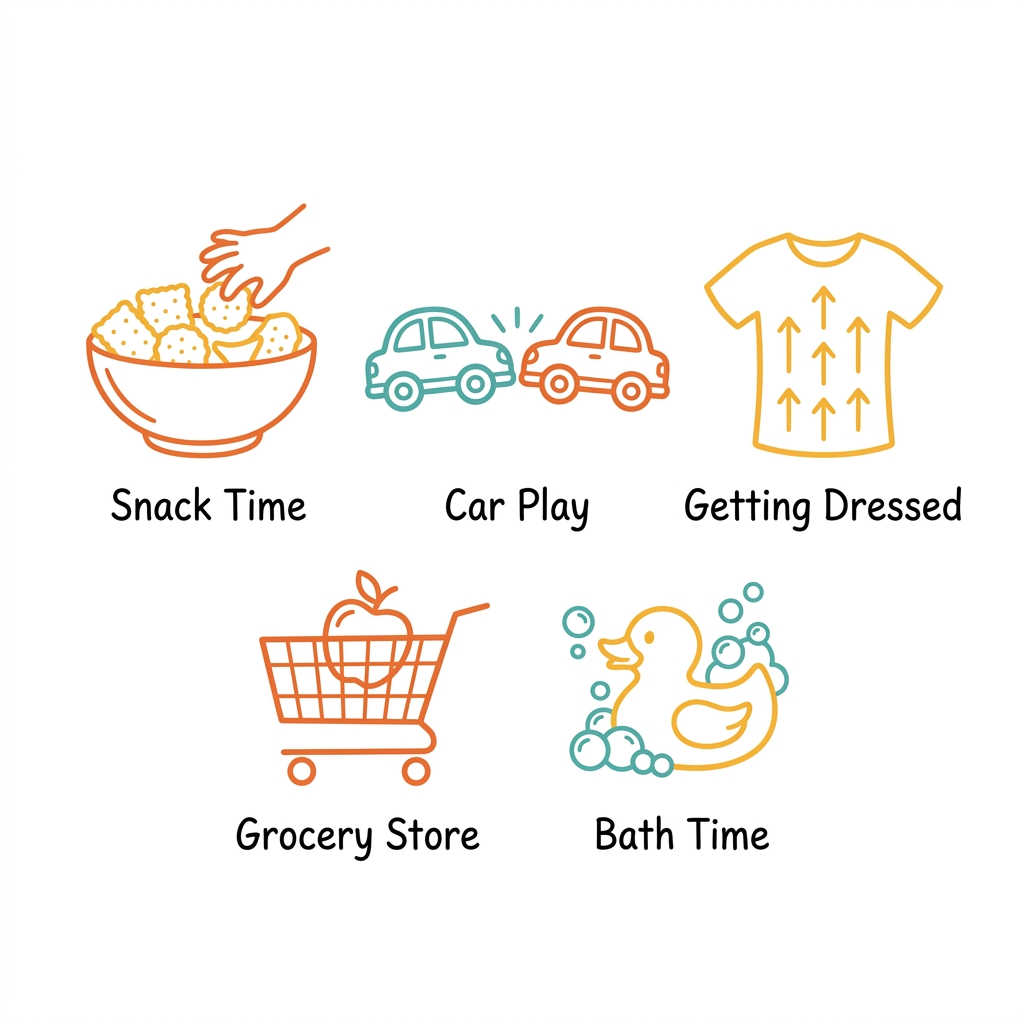
Five everyday NET routines for toddler play.
These simple, play-based moments give your toddler hundreds of natural repetitions every week, and because they happen with familiar people and favorite things, the new skills start to stick. That’s what we mean by real progress, real connection — not just at the therapy table, but in the middle of a real-life game or a trip to the store.
Teaching Communication Through Play-Based ABA
In our hands-on ABA therapy for children who learn differently, every play session becomes a communication-rich lab. We target the core language skills that build conversation, using each child’s unique motivations:
- Manding (requesting): Your child learns that words bring things — saying “juice” actually gets them juice.
- Tacting (labeling): They learn to name objects they see, like “apple” at the grocery store, just by hearing the word paired with the item.
- Echoics (imitating sounds): The therapist models a sound or word, and your child echoes it, building the foundation for speech.
- Intraverbals (answering questions): Simple fill-in-the-blank games like “Ready, set… go!” teach your child to complete phrases and engage in back-and-forth.
Turn-taking during car play isn’t just about sharing — it’s the beginning of social reciprocity, where your child learns to watch, wait, and respond to another person’s actions. Because every child is different, we match activities to what your child loves most, whether it’s cars, water play, or snacks. That personalized touch means communication skills grow as a natural part of their favorite routines, and parents see those sparkly moments of connection every day.
How In-Home ABA Therapy Promotes Skill Generalization
Natural environment teaching ABA is even more powerful when it happens in your home. When we use your family’s own toys, your child’s own high chair, and the same voices they hear at breakfast, skills don’t stay stuck in a clinic — they transfer naturally across people, places, and materials. That’s generalization, and it’s one of the biggest reasons we bring therapy into kitchens, playrooms, and backyards in Springfield, MO.
Our BCBA designs a personalized therapy plan around your child’s strengths and interests, and our RBT team brings that plan to life with care that comes straight from the heart. Because you’re present or actively participating, you learn the same strategies we use, so your child hears consistent cues whether it’s therapy time or a regular Tuesday afternoon. That kind of seamless coaching often helps a child who learns to ask for “more” during a session carry that word right into dinner time with the whole family.
While every child’s journey is unique, and results may vary, in-home NET creates the best conditions for skills to become truly automatic. Please consult a healthcare professional for diagnosis and treatment.
Taking Natural Environment Teaching Further: Advanced Strategies for Generalization
The ultimate goal of natural environment teaching ABA is generalization — helping children carry skills from one context effortlessly into another. When a child can ask for help in the living room, at school, and while running errands, they are truly learning in everyday environments. We focus on systematic skill transfer across people, places, and materials so real progress brings real connection.
Expanding NET Beyond the Living Room
Home routines offer rich teaching moments: practicing turn-taking during mealtime, labeling bath toys, or following instructions at bedtime. At school, naturalistic teaching expands during centers, recess, and hallway transitions where a child interacts with peers and teachers. Community outings deepen generalization further — waiting calmly at the grocery store, greeting a neighbor at the park, or choosing a snack in a waiting room.
We vary the people involved (parents, siblings, RBTs, teachers) and the materials used (household items, school supplies, playground equipment) so skills transfer broadly. Whether serving families in Springfield, in St. Louis, or in Columbia, our BCBA-led teams embed learning into your child’s real-world experiences.
Blending NET with DTT and IEP Goals
Discrete Trial Training (DTT) provides structured, table-based repetition for skill acquisition, while natural environment teaching ABA brings those skills alive in play-based, everyday moments. These approaches complement rather than compete with each other.
In school, we align NET targets with Individualized Education Program (IEP) goals through our IEP coordination and school collaboration service. Teachers, aides, BCBAs, and parents plan generalization as one team. A child practicing requesting at the table with DTT can then generalize that skill during lunch choices or recess conversations. This team-based planning keeps the personalized therapy plan consistent across settings.
Measuring Progress in Natural Settings
Heart Core ABA uses naturalistic progress measurement that respects how real learning unfolds. Our BCBAs conduct cold probes and generalization checks during play-based sessions, collecting data across different settings and people — at home, in the classroom, and around the community.
Each week, parents receive updates explaining the concrete skills their child is showing and how we are adjusting the personalized therapy plan based on that data. Our BCBA-led teams with consistent RBT matches supervise every session so subtle improvements never go unnoticed. We are committed to hands-on ABA therapy for children who learn differently, delivering care that comes straight from the heart.
Results may vary. Information on this site is not a substitute for professional medical advice.
Frequently Asked Questions About Natural Environment Teaching
Still wondering what natural environment teaching means in practice? We use natural environment teaching aba to teach skills in familiar places like home, school, and play.
What is natural environment teaching in ABA? It’s an ABA method that teaches skills in everyday settings, following your child’s interests and motivation. We follow your child’s lead during play and routines instead of structured table work.
Where do NET sessions take place? We weave natural environment teaching aba into in-home, school-based, and center-based sessions. Everyday moments — mealtimes, outdoor play, and family routines — become natural learning opportunities.
What skills can NET help build? NET builds communication, social interaction, play skills, daily living skills, and generalization. Each session is hands-on ABA therapy for children who learn differently, turning everyday moments into real progress, real connection.
Is NET right for my child? A BCBA assessment creates a personalized plan. Results vary; consult a professional for medical advice.
Real Progress Begins with Natural Environment Teaching at Heart Core ABA
Real progress begins in everyday moments, not just at a table. Natural environment teaching ABA helps children learn skills where they live, learn, and play. Here’s a quick look at how NET compares with discrete trial training:
| Dimension | Discrete Trial Training (DTT) | Natural Environment Teaching (NET) |
|---|---|---|
| Setting | Table or structured clinical area | Real-life settings: home, school, community, play |
| Instructional Lead | Therapist-directed with repeated trials | Child-motivated through natural play and routine |
| Reinforcement | Tokens, edibles, or praise after correct responses | Natural outcomes embedded in the activity itself |
| Generalization | Often requires separate practice across environments | Built into the learning context automatically |
| Best Suited For | Discrete skills like matching, imitation, or rote tasks | Communication, social, daily living, and play skills |
Because learning is woven into natural routines, children more readily generalize skills — though results vary. Our BCBA-led teams with consistent RBT matches deliver hands-on, play-based ABA for children who learn differently, creating real connection through care that comes straight from the heart. Discover the naturalistic ABA therapy benefits — reach out today. If you’re in Springfield, Missouri, or our other service areas, we’d love to connect. Results may vary; this information does not substitute for medical advice.