








School Based ABA Therapy Programs
Table of Contents
Understanding School-Based ABA Therapy Programs
What Is School-Based ABA Therapy?
School based ABA therapy programs deliver applied behavior analysis in the classroom, supervised by a Board Certified Behavior Analyst (BCBA) and supported by school staff. Our school based aba therapy program brings Hands-on ABA therapy into the child’s learning environment, promoting skill generalization and collaboration with IEP teams. According to the CDC, autism affects 1 in 36 children, so in school ABA therapy is more critical than ever. At Heart Core ABA, we provide personalized aba therapy at school in Springfield, MO.
Quick Links: Top 5 Questions About School-Based ABA Therapy
When exploring school based ABA therapy, families have many questions about payment, IEP coordination, school credentials, timelines, and advocacy. Click any of the questions below to jump directly to the answer — each one reflects our commitment to real progress, real connection, and care that comes straight from the heart.
- Cost & Insurance – Breaking down payment options and insurance steps.
- Process & IEP Coordination – Steps to coordinate therapy with your child’s school.
- School & Credentialing – How our BCBAs partner with your school team.
- Timeline & Progress – What to expect and when to see gains.
- Advocacy & Program Selection – Tools to navigate options and speak up for your child.
Cost and Insurance for School-Based ABA Therapy
Now that you understand how school-based ABA therapy works, let’s talk about the costs and insurance options for school based aba therapy programs.
Are school-based ABA therapy programs covered by private insurance or Medicaid?
Yes, many private insurance plans and Medicaid cover school based aba therapy. Coverage depends on the child’s diagnosis, plan type, and state regulations. According to the Centers for Medicare & Medicaid Services (Medicaid.gov), ABA therapy is a covered benefit under Medicaid in many states, though eligibility requirements vary. Many private plans also cover ABA therapy under mental health parity laws. Heart Core ABA offers aba therapy services and can verify your insurance benefits, coordinate prior authorization, and help determine your coverage. We help families navigate insurance complexities so they can focus on their child’s progress. Please verify insurance coverage and that prior authorization may be required.
How can families access school-based ABA therapy without insurance?
Yes, families can access school-based ABA therapy without insurance through private pay options. At Heart Core ABA, we provide transparent pricing and can help you explore financial options. Depending on your situation, we may offer sliding scale fees or payment plans to make therapy more affordable. Whether your child needs in school aba therapy or support with a personalized therapy plan, we work to create a path that fits your family’s budget. Our team is happy to discuss your options and answer any questions about private pay. We believe every child deserves access to therapy, regardless of insurance status. With care that comes straight from the heart, we are committed to finding solutions so every child can receive the support they need.
What are the typical costs of school-based ABA therapy programs?
Costs for school-based ABA therapy programs vary based on hours, location, and provider. Out-of-pocket expenses can differ for private pay and insurance-negotiated rates. Many families find that after insurance approval, they pay little to nothing out-of-pocket. The total cost also depends on the intensity and duration of therapy, with more hours typically increasing the overall expense. We offer transparent pricing for aba therapy at school, and our team can provide a personalized cost estimate based on your child’s needs and coverage. Real progress, real connection–we make therapy accessible and straightforward by guiding you through the financial details. Once you’ve reviewed your coverage options, our team can help you take the next step with personalized, school-based support.
Process and IEP Coordination for In-School ABA Therapy
When school based aba therapy programs become part of your child’s day, they must work hand-in-hand with the IEP. Our hands-on approach to in school aba therapy ensures every minute of therapy supports academic and behavioral goals.
Here’s a look at how the coordination process typically unfolds:
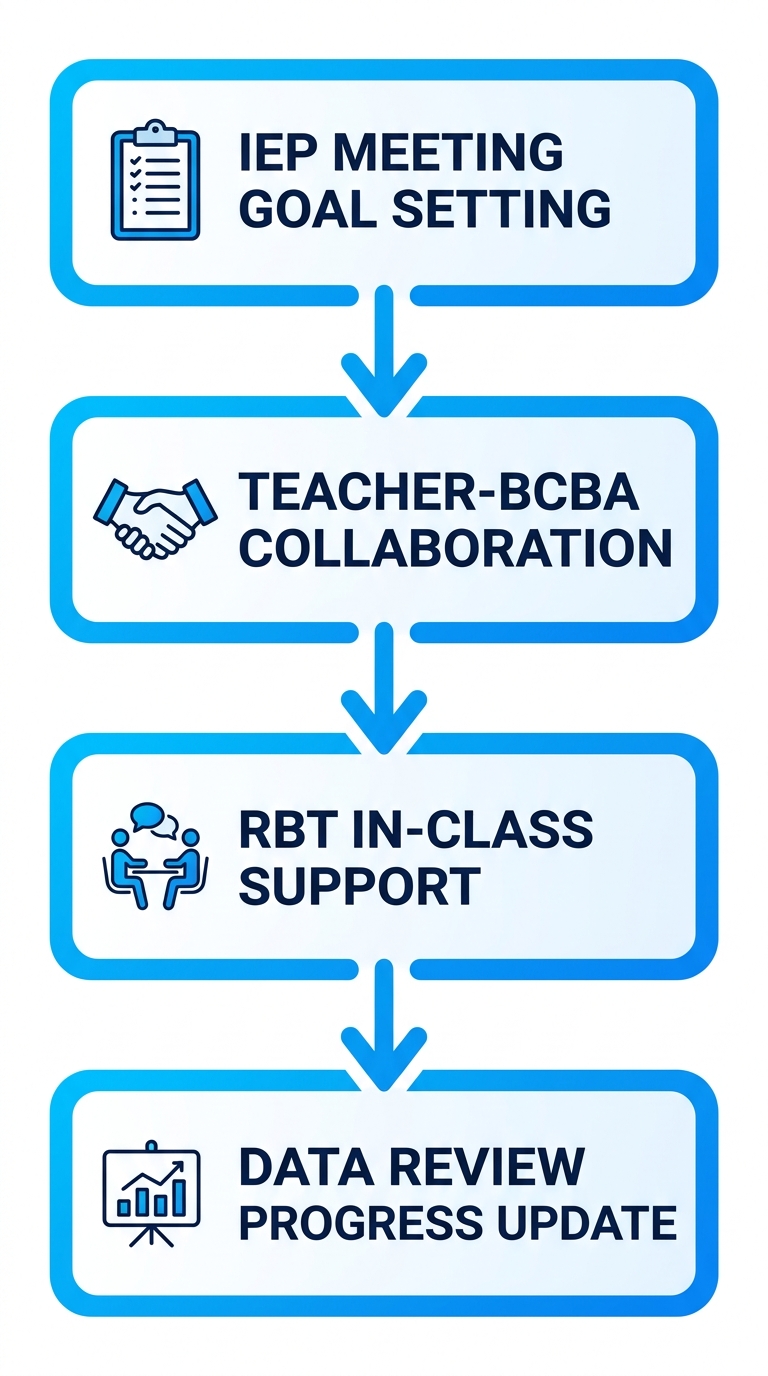
In-school ABA therapy coordination process
How do school-based ABA therapy programs coordinate with an existing IEP?
When we provide school based aba therapy, our BCBAs join IEP meetings to collaborate on goals that match your child’s academic plans. Under IDEA, the U.S. Department of Education requires related services like ABA to support academic and behavioral progress. We turn IEP benchmarks into ready-to-use skill targets–communication, social skills, or classroom routines–so every session reinforces the school’s efforts. This keeps therapy focused and helps your child make strides without losing core instruction time.
How do therapists in school-based ABA programs collaborate with classroom teachers?
Our approach to aba therapy at school includes daily check-ins with the classroom teacher. Registered Behavior Technicians (RBTs) share behavior intervention plans (BIPs) and simple strategies the teacher can use throughout the day–such as visual prompts or break cards–to support your child. We pull students for one-on-one or small-group sessions during quiet moments like independent reading or transitions, so they don’t miss core instruction. This ongoing communication means the teacher always knows what’s working, and we can adjust the plan together as your child grows.
What does a typical in-school ABA therapy session look like?
A session starts with a quick warm-up activity–maybe a favorite song or game–to build rapport. Then our RBT leads targeted skill practice using naturalistic teaching: social turn-taking during recess, requesting snacks at break, or following multi-step directions for an art project. Throughout, we collect data to track progress and adjust the plan. Each session ends with a cool-down and a brief note for the teacher so the classroom stays in the loop. This rhythm makes therapy feel less like work and more like real connection.
While every child’s journey is unique, this close coordination, fueled by care that comes straight from the heart, lays the groundwork for meaningful progress that extends beyond the classroom.
School Requirements and BCBA Credentials for ABA Therapy
For many families, aba therapy at school supports children’s academic and social growth. Knowing the requirements for school based aba therapy programs helps ensure a smooth integration with your child’s education.
What role does a BCBA play when providing ABA therapy at school?
A Board Certified Behavior Analyst (BCBA), certified by the Behavior Analyst Certification Board (BACB), leads assessment, treatment design, and RBT supervision. When delivering school based aba therapy, the BCBA works with the IEP team to align goals with classroom routines and policies. At Heart Core ABA, our BCBAs have extensive experience in Missouri schools, creating personalized therapy plans that support real progress. We coordinate with teachers to make therapy a natural part of the school day. This ensures interventions are ethical and data-driven.
Can a student receive school-based ABA therapy without an IEP?
Typically, a student needs an IEP or 504 plan to receive in school aba therapy as a related service under IDEA. Some schools allow private ABA providers on campus if families arrange it independently. Without an IEP, parents can discuss options with school administration and an ABA provider like Heart Core ABA. We can guide you through possible pathways and help coordinate with the school. Our focus remains on care that comes straight from the heart, supporting each child’s growth whether through an IEP or private arrangement.
Timeline and Progress Tracking in School-Based ABA Therapy
Once a school-based program is in place, families often wonder how progress is measured and how much time it requires. Heart Core ABA’s school based ABA therapy programs combine data with scheduling, using aba therapy at school to support academic and social goals.
How is progress tracked during school-based ABA therapy sessions?
During school based ABA therapy, our RBTs collect precise data on every skill acquisition, behavior frequency, and goal mastery milestone. A BCBA analyzes this information weekly and updates the personalized therapy plan, so strategies stay aligned with your child’s evolving needs. We share clear, weekly progress reports with families and school staff, fostering open communication. The CDC notes that 1 in 36 children are diagnosed with autism, making structured progress monitoring essential. Our hands-on approach turns that monitoring into real progress and real connection.
Does school-based ABA therapy take place during the entire school day?
In school ABA therapy is not a full-day program; instead, it is delivered in focused blocks during the school day. We work with teachers to select times that avoid key academic instruction, so your child benefits from therapy without missing core subjects. The length of each session is determined by the student’s IEP goals and energy levels, never a one-size-fits-all schedule. Contact our team for an ABA therapist near me who can help design a balanced school-based program.
Understanding how we track progress helps parents see the clear results of our approach.
Parent Advocacy and Choosing the Right School-Based ABA Program
Parents are key advocates for their child’s in school aba therapy. Here’s how to advocate and choose the right program.
How can parents advocate for having ABA therapy at school?
When exploring school based aba therapy programs, parents often start by understanding their rights under IDEA. Under the Individuals with Disabilities Education Act, parents have the right to request an IEP meeting. We encourage parents to cite their child’s diagnosis and present a letter from their BCBA outlining the need for aba therapy at school. According to the CDC, 1 in 36 children are diagnosed with autism, underscoring the need for support. Heart Core ABA provides sample advocacy letters and guidance. (Information on this site is not a substitute for professional medical advice.)
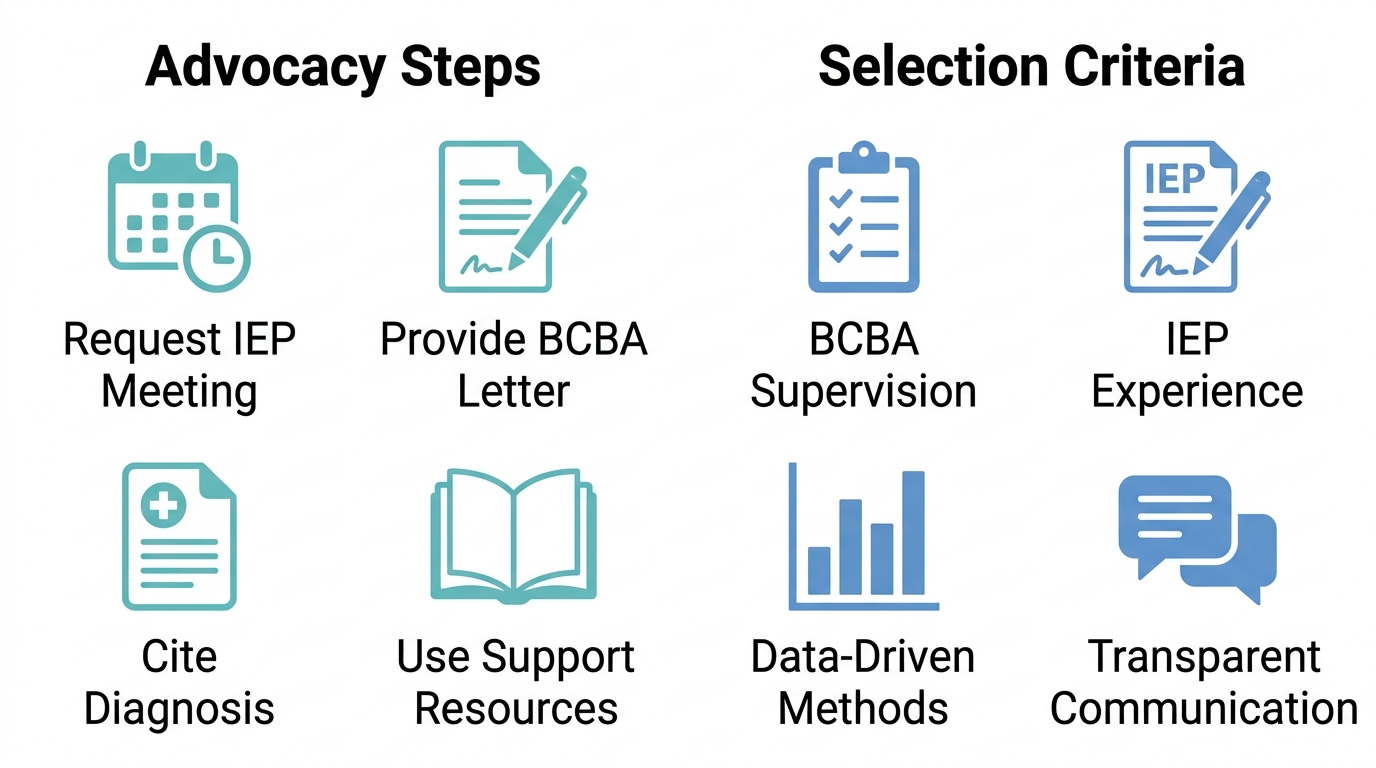
Key steps for advocating and selecting school-based ABA programs
What criteria should families use to choose a school-based ABA therapy program?
When evaluating school based aba therapy options, families should prioritize programs with BCBA supervision, experience with IEP teams, and data-driven progress tracking. Transparent communication is essential. Heart Core ABA meets these criteria with our personalized, BCBA-led approach that includes IEP coordination and consistent parent updates. We work closely with schools to align therapy goals with educational objectives, creating a cohesive support system. Our aba therapy springfield program exemplifies this hands-on ABA therapy for children who learn differently, with regular updates and adaptive strategies to help children achieve real progress and real connection.
Still Have Questions About School-Based ABA Therapy? We’re Here to Help
If you still have questions about school based aba therapy programs, we’re here to help. Our BCBA-supervised team can explain school based aba therapy and how aba therapy at school benefits your child’s education and IEP.
We also assist with insurance verification, including Medicaid (prior authorization may be required). Contact us today for a free consultation and discover how in school aba therapy can personally support your child with care that comes straight from the heart.
Resources












 At-Home
ABA Therapy
At-Home
ABA Therapy Best
ABA Therapists
Best
ABA Therapists BCBAs
Near Me
BCBAs
Near Me RBTs
Near Me
RBTs
Near Me