Table of Contents
- Social Skills Groups for Autism in Missouri
- What Are Social Skills Groups for Autism?
- Combining Social Skills Groups with ABA Therapy
- Finding Social Skills Groups and Activities in Missouri
- Age Considerations and Specialized Interventions for Social Skills
- Common Questions About Social Skills Groups for Autism
- Resources
Social Skills Groups for Autism in Missouri
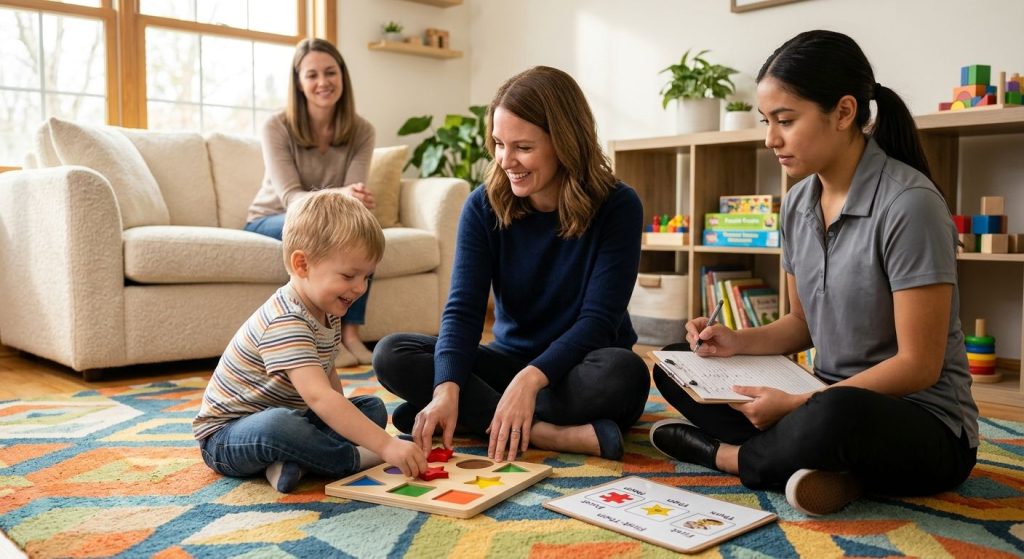
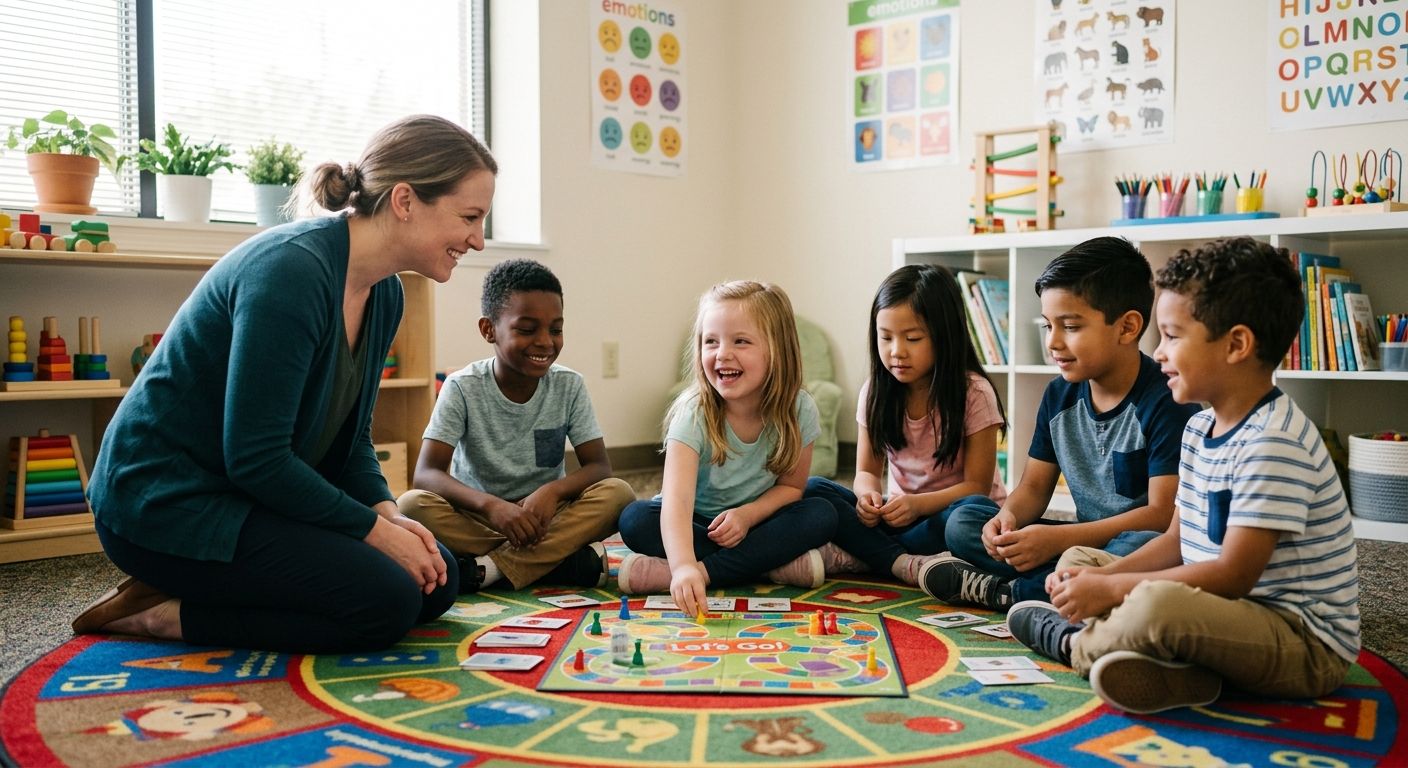
Beyond individualized therapy, our social skills groups autism program offers a unique opportunity for peer interaction in a structured setting. These small-group sessions, typically involving 3–5 children, are led by a BCBA or trained RBT and focus on building turn-taking, conversation initiation, and reading social cues in a supportive environment.
Our approach relies on play-based and naturalistic teaching methods rooted in ABA principles. Children engage in autism social skills activities children enjoy, such as cooperative games and role-playing, while learning through incidental teaching and peer modeling. Because groups are age-matched and skill-level matched, each child receives the right balance of challenge and encouragement, with individualized goals integrated into every session. We also incorporate social skills interventions autism research supports, ensuring our groups reflect evidence-based practices. Families across Missouri, including Springfield, St. Louis, Kansas City, and Columbia, can access these group-based social learning opportunities as part of our personalized therapy plan.
At HeartCore ABA, we believe in care that comes straight from the heart, which is why our team provides weekly updates on your child’s progress. While results may vary, these groups give children a low-pressure space to practice essential social skills. To learn more or enroll, visit our website and search for ABA therapy near me in your Missouri community today.
These groups work hand-in-hand with our other services, such as parent coaching and early intervention, to support every aspect of your child’s development.
What Are Social Skills Groups for Autism?
Social skills groups for children with autism are small, structured gatherings where peers come together to learn and practice the art of connection. Typically comprising 3 to 6 children, these sessions are led by a trained facilitator, often a Board Certified Behavior Analyst (BCBA) or a Registered Behavior Technician (RBT) under BCBA supervision. The purpose is to build the foundational social abilities that support friendship, cooperation, and everyday communication. Through explicit instruction in turn-taking, initiating conversations, reading facial expressions, and sharing, these groups translate abstract social rules into tangible, practice-ready skills. For many families, exploring social skills groups autism programs marks a pivotal step in their child’s developmental journey.
At Heart Core ABA, we take this a step further by weaving these groups directly into our ABA therapy model. Our BCBAs design data-driven goals for each child, ensuring that every session targets meaningful progress. The activities are dynamic and engaging, blending role-play scenarios, cooperative games, video modeling, and naturalistic peer interactions. This play-based approach keeps children motivated while they master critical autism social skills activities children need for success at home, in school, and on the playground.
Not All Social Skills Groups Are Created Equal
Parents researching social skills interventions autism often discover that program quality varies dramatically. Understanding the differences between common delivery models can help you make an informed choice. The table below contrasts a typical standalone social skills program with an integrated, BCBA-supervised model like ours.
| Feature | Integrated Group Model | Standalone Program |
|---|---|---|
| Approach | Social skills group fully embedded within ABA therapy | Standalone Social Skills Program |
| Structure | BCBA-directed, data-driven goals | May not be overseen by a BCBA |
| Generalization | Generalization support built in | Limited carryover to natural settings |
| Family Involvement | Parent coaching and weekly updates | Varies widely |
| Cost & Coverage | Insurance covered (Medicaid/private) | Often private-pay only |
The distinctions are clear. An integrated approach provides consistent oversight from a BCBA, meaning every activity is purposeful and progress is measured. In contrast, standalone programs often lack this clinical backbone, which can limit how well skills transfer to real life.
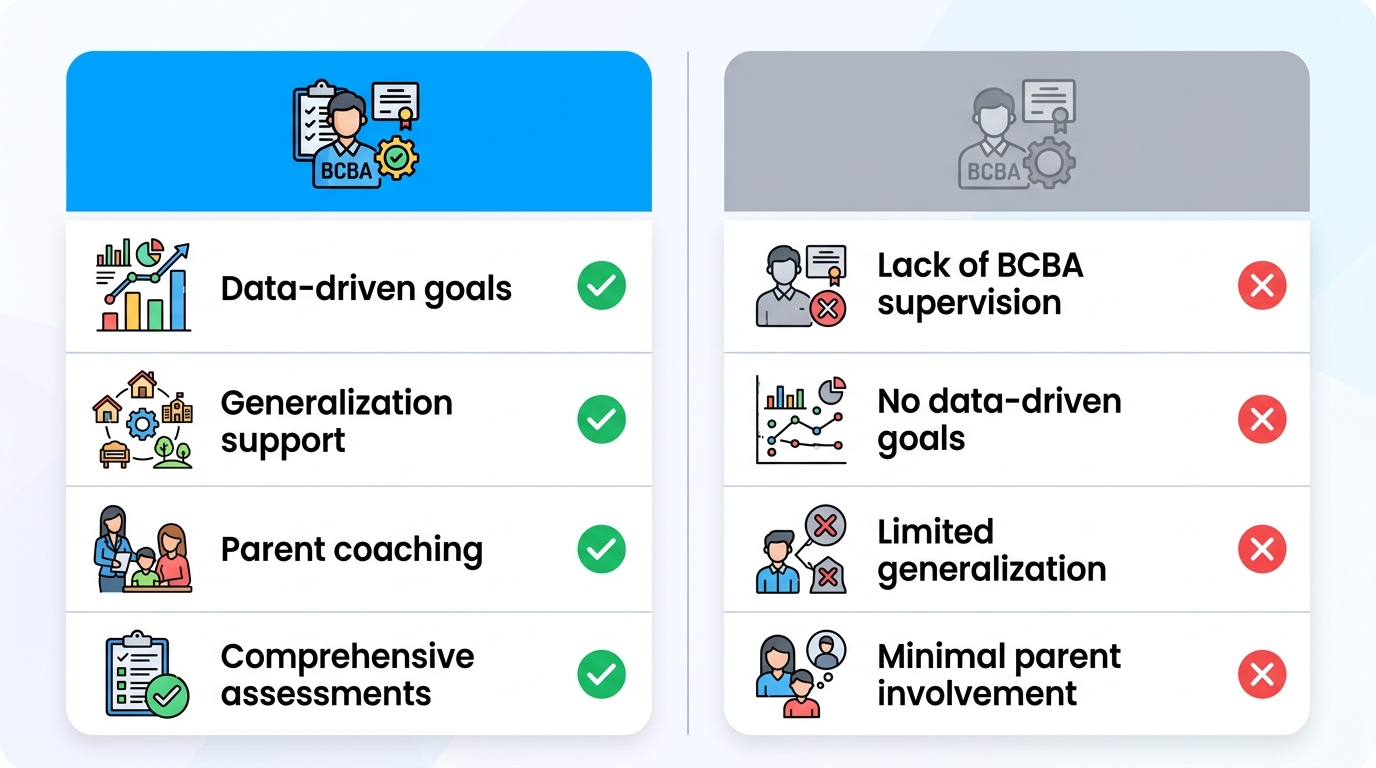
Comparison of integrated ABA social skills model versus standalone programs.
Why an Integrated Model Leads to Better Outcomes
When social skills training is embedded within a comprehensive ABA program, generalization happens more naturally. Our team doesn’t just teach a child to take turns at the center; we work with parents and school teams to reinforce that same skill at home and in the classroom. Our groups follow the rigorous standards of the Behavior Analyst Certification Board (see BACB certification requirements), which means our BCBAs provide ethical, high-quality supervision for every session.
This wraparound support sets the stage for durable progress. By combining data-driven group instruction with parent coaching and real-world practice, an integrated model helps children build friendships that feel authentic and lasting. The structure we provide turns social learning into a celebration of small victories, creating a foundation where real progress and real connection flourish.
Combining Social Skills Groups with ABA Therapy
Now that we have explored the value of social skills groups, let’s dive into how ABA techniques make these groups even more effective. At Heart Core ABA, we combine the natural benefits of peer interaction with the structured, evidence-based principles of Applied Behavior Analysis to help children build lasting, meaningful social connections. Our Personalized therapy plan ensures that every group session targets the specific communication and relationship-building goals that matter most for your child. Whether we are working on basic turn-taking or advanced peer negotiation, we use gentle, data-driven methods in every social skills group for children in Springfield, MO and beyond, making the process both effective and enjoyable.
We design these offerings to support social skills groups autism and collaboration.
How ABA Principles Structure Social Skills Groups
We use task analysis to break social interactions into teachable steps, such as greeting, asking a question, waiting for an answer, and responding. During role-play exercises we provide systematic prompts, fading support as children master each step, and we deliver immediate, specific praise and natural reinforcement to encourage repetition. We apply social skills interventions autism in group contexts by pairing peers for practice, rotating roles to encourage perspective-taking, and tracking session data. That data helps us refine goals within a Personalized therapy plan, keeping practice targeted and meaningful.
Age-Appropriate Social Skills Interventions
We serve children from 2 to 16 years, grouping by developmental profile so peers share similar skill needs. For toddlers (2–4) we focus on joint attention, shared affect, turn-taking, and parallel play using simple, play-based prompts and short routines to reduce overwhelm. School-age groups work on initiating back-and-forth exchanges and reading basic nonverbal cues. For older children and teens we tackle sarcasm detection, peer negotiation, perspective-taking, and conflict resolution through structured role-plays and real-world scenarios. We design each group so social skills groups autism match developmental readiness while promoting independence.
We offer center-based, school-based, and in-home groups to meet different needs across locations and routines for children in nearby communities.
The table below shows how each setting targets social skills.
| Setting | Activities Included | Skills Targeted | Best For |
|---|---|---|---|
| Center-based | Role-play, board games, group stories | Turn-taking, conversation starters | Children who need a structured, distraction-controlled environment |
| School-based | Lunch bunches, recess clubs, cooperative projects | Peer negotiation, sharing, following group instructions | Children who need generalization in natural peer settings |
| In-home group (with siblings/peers) | Snack time, parallel play, structured games | Waiting, sharing, initiating play | Younger children or those with high anxiety about new settings |
Choose a setting based on your child’s needs: structure, generalization opportunities, or comfort in the home, and clinical goals.
Generalizing Skills Across Settings
We use peer-mediated interventions, video modeling, and parent coaching to help children apply skills across home, school, and community. We recommend families explore general child-development milestones from CDC public health resources to track autism social skills activities children and progress.
Results may vary. Consult a healthcare professional for diagnosis and treatment. Verify insurance coverage and that prior authorization may be required. Information on this site is not a substitute for professional medical advice.
Once you understand the value of social skills training, the next step is finding the right activities and groups. For families exploring social skills groups autism therapy, knowing what specific interventions help children build meaningful connections makes the search much easier. We focus on hands-on ABA therapy for children who learn differently, using play-based strategies that feel natural and engaging.
What Activities Are Included in Autism Social Skills Therapy?
Autism social skills activities children practice in therapy target several key developmental areas. We organize these activities around communication, play, and problem-solving so each child works on the skills most relevant to their Personalized therapy plan. The table below highlights some of the most common activities we use, the specific skill each one teaches, the typical age range, and what materials are needed.
| Activity | Skill Taught | Typical Age Range | Materials Needed |
|---|---|---|---|
| Turn-Taking Game (e.g., board game) | Waiting, sharing turns, handling win/loss | 3–7 years | Simple board game, tokens, visual timer |
| Conversation Starter Circle | Initiating conversation, asking questions, maintaining topic | 5–12 years | Conversation starter cards, talking stick |
| Cooperative Art Project | Collaboration, negotiating roles, complimenting | 4–10 years | Large paper, markers, task cards |
| Role-Play Social Scenarios | Problem-solving, empathy, assertiveness | 6–14 years | Scenario cards, props, feedback forms |
These structured activities give children a safe environment to practice new skills before applying them in real-world settings. Parents can reinforce turn-taking by playing board games during family time, or try simple role-play at home using everyday situations like ordering food or greeting a neighbor.
How to Find Social Skills Groups in Missouri
Knowing which activities help is the first step—now here’s how to actually find a social skills group near you in Missouri. Our team offers social skills groups in Springfield, Kansas City, St. Louis, and Columbia, Missouri, and we coordinate closely with schools and families to make the process straightforward. Social skills interventions autism research supports often work best when therapy is consistent across home, school, and community settings, so finding the right group matters.
Follow these steps to locate a group that fits your child’s needs:
- Check with your child’s school district. Many districts offer IEP-based social skills groups. Contact your child’s school to ask about school based ABA therapy options they offer or coordinate with. We work directly with schools to align therapy goals with classroom expectations.
- Search the BACB registry. The Behavior Analyst Certification Board maintains a public directory of Board Certified Behavior Analysts. You can search by location to find BCBAs in Missouri who run social skills groups or can recommend local programs.
- Contact Heart Core ABA for a free consultation. We verify your insurance benefits, explain any prior authorization requirements, and help you understand your coverage before you commit. Our team provides clear pricing and can recommend groups that match your child’s age and skill level. This approach reflects care that comes straight from the heart—Real progress, real connection is what we aim for with every family.
- Join online parent support groups. Local Facebook groups and autism parenting networks are excellent sources of peer recommendations. Other parents in Missouri can share their experiences with specific social skills programs and therapists.
We understand that navigating insurance and finding the right provider can feel overwhelming. Our team handles the logistics so you can focus on your child’s growth. Ready to explore options? Contact Heart Core ABA for a free consultation.
Consult a healthcare professional for diagnosis and treatment. Results may vary. Information on this site is not a substitute for professional medical advice.
Age Considerations and Specialized Interventions for Social Skills
Because social development milestones vary drastically, groups are structured by age. social skills groups autism programs tailor focus skills, session length, and staff support to match each developmental stage. These social skills interventions autism are not one-size-fits-all; they follow evidence-based parameters that give every child the right balance of challenge and support.
The table below outlines the typical framework. Remember, these are starting points that we adjust after your child’s initial assessment.
| Activity | Skill Taught | Typical Age Range | Materials Needed |
|---|---|---|---|
| Turn-Taking Game (e.g., board game) | Waiting, sharing turns, handling win/loss | 3–7 years | Simple board game, tokens, visual timer |
| Conversation Starter Circle | Initiating conversation, asking questions, maintaining topic | 5–12 years | Conversation starter cards, talking stick |
| Cooperative Art Project | Collaboration, negotiating roles, complimenting | 4–10 years | Large paper, markers, task cards |
| Role-Play Social Scenarios | Problem-solving, empathy, assertiveness | 6–14 years | Scenario cards, props, feedback forms |
We use these parameters as a foundation, then personalize everything. For toddlers, a 1:1 or 1:2 ratio creates the safe, supported space needed for joint attention and parallel play. As children grow, our preschool groups introduce autism social skills activities children love, including games that teach turn-taking and sharing during 45-minute sessions. By school age, 60-minute sessions build conversation skills and perspective-taking within small 1:4 peer circles.
For adolescents, the focus shifts to navigating sarcasm, self-advocacy, and peer negotiation in 60- to 75-minute groups. We also coordinate with your child’s school, tapping into special education department of education resources to align group goals with IEP or 504 supports. Each plan is a personalized therapy plan designed to build real progress, real connection. Results may vary, and we encourage you to reach out so we can build the right group fit for your child.
Ready to learn how we transform these parameters into a daily growth plan? Let’s walk through our approach to customizing social skills programs next.
Common Questions About Social Skills Groups for Autism
Here are answers to the most common questions we hear from families about our social skills groups for children with autism.
What are social skills groups autism?
These are small, facilitated groups that teach peer interaction, turn-taking, and conversation skills. They help children practice social skills interventions autism in a supportive setting.
What age groups can join?
Groups typically serve ages 3 to 12, with children grouped by developmental level, not just age. This ensures autism social skills activities children are relevant to each child’s needs.
What skills will my child learn?
Children learn to read social cues, share, and initiate play. These skills build confidence and make real progress toward real connection with peers.
How do social skills groups fit into ABA therapy?
These groups are part of our comprehensive ABA therapy in Springfield. Led by BCBA-supervised RBTs, they integrate into each child’s personalized therapy plan.
Our social skills groups for autism help children build meaningful friendships and confidence through play-based, BCBA-led sessions. We also bring compassionate ABA therapy into your home, school, or one of our welcoming centers in Springfield, MO, St. Louis, MO, Kansas City, MO, Columbia, MO, and Chesterfield, VA. Every plan pairs structured social skills interventions with parent coaching and hands-on autism social skills activities children genuinely enjoy. Real progress, real connection — that’s care that comes straight from the heart. Contact us today to schedule your free consultation.
Results may vary. Consult your healthcare professional for diagnosis and treatment.