
Table of Contents
- Your Guide to Early Intervention Autism Strategies in 2026
- Understanding the Latest Early Intervention Strategies for Autism in 2026
- Key Benefits of Early Intervention for Toddlers with Autism in 2026
- How Early Intervention ABA Therapy Works: From Assessment to Progress
- Best Practices for Implementing Early Intervention Strategies at Home and School
- Supporting Your Child’s Development Through Early Intervention
Your Guide to Early Intervention Autism Strategies in 2026
If you’re exploring early intervention autism strategies 2026, you’re already taking a powerful first step. Research shows that beginning support during toddler years can significantly improve communication and daily living skills. As we learn more each year, the best approaches combine evidence-based methods with a child’s everyday routines.
Natural environment teaching is a leading approach in 2026 that helps children learn through familiar play and daily activities. Instead of structured drills, this method uses your child’s natural interests—whether it’s stacking blocks in the living room or naming snacks at the kitchen table—to build communication and social skills in Kansas City homes.
Parent-mediated intervention is another essential strategy gaining momentum this year. This approach trains parents to use therapeutic techniques during regular routines, from mealtime to bath time. By empowering families in St. Louis and across Missouri, this method ensures that skill-building happens throughout the day, not just during scheduled sessions.
At Heart Core ABA, our compassionate ABA therapy programs blend natural environment teaching and parent coaching into a personalized plan designed around your child’s unique strengths. Real progress, real connection—that’s what we’re here to build.
Understanding the Latest Early Intervention Strategies for Autism in 2026
Now that we’ve explored the early signs of autism, let’s look at the most effective ways to respond. For families seeking support, the landscape of early intervention autism strategies 2026 has evolved to focus on personalized, naturalistic approaches that fit seamlessly into a young child’s daily life. At Heart Core ABA, we believe the best therapy doesn’t just build skills—it creates connection, confidence, and lasting progress. We deliver hands-on ABA therapy in the comfort of your home, right here in the Kansas City area and across Missouri and Illinois.
The following table provides a quick overview of three leading models shaping early intervention today.
| Approach | Setting | Who Delivers | Parent Role | Best For |
|---|---|---|---|---|
| Natural Environment Teaching (NET) | Home, playground, community | RBT with BCBA supervision | Active participant during sessions; extends learning between sessions | Skill generalization, toddlers, social communication |
| Parent-Mediated Intervention | Home and daily routines | Parent as primary (coached by BCBA) | Delivers strategies throughout day; receives BCBA coaching weekly | Families seeking carryover, consistency, empowerment |
| Traditional Discrete Trial Training (DTT) | Tabletop, structured setting | RBT or BCBA | Practice at home with provided materials | Rapid skill acquisition, early learners |
These approaches aren’t mutually exclusive. A high-quality early intervention plan often blends multiple strategies. In the next sections, we’ll dive deeper into each one, showing how they work and how we use them to help children in Kansas City and beyond build communication, confidence, and independence.
Natural Environment Teaching: Learning Through Play and Daily Routines
Natural environment teaching is a core part of modern ABA. It takes the powerful principles of behavior analysis and applies them where your child already spends time—during meals, bath time, backyard play, or trips to the park. Instead of sitting at a table to run drills, a Registered Behavior Technician (RBT), guided by a Board Certified Behavior Analyst (BCBA), uses your child’s natural motivations to teach new skills. This approach leverages activities a child already enjoys, turning them into opportunities for learning. The biggest benefit is generalization; a toddler who learns to request a snack during a play kitchen routine is far more likely to use that same skill when they are hungry in the real kitchen. We’ve seen that learning through daily routines makes skill-building feel like living, not like a lesson. A session in a St. Louis home might look like working on communication while playing with a favorite train set, followed by practicing self-help skills during a real snack time.
NET vs. DTT: When to Use Each
So, when does traditional tabletop work fit in? Discrete Trial Training (DTT) remains a powerful, structured method for rapidly building a new skill through repetition and clear reinforcement. It’s often ideal for early learners who need to master foundational concepts like matching or imitation. The 2026 trend, however, leans heavily toward NET for younger toddlers. Once a skill is introduced in a DTT format, an RBT can immediately shift to a NET session, practicing the same concept while your child is on a swing or exploring a sandbox, ensuring the skill is truly understood and usable in their world.
Parent-Mediated Intervention: Empowering Families to Lead the Way
What if the most powerful therapist in your child’s life is you? That’s the idea behind parent-mediated intervention. In this model, a BCBA coaches you, the parent, to implement ABA strategies throughout your everyday routines. The evidence base for this approach is strong, showing that when families are empowered, children make more consistent gains. At Heart Core ABA, this isn’t just homework; it’s a core service. We help you turn bath time into a communication lesson or a trip to the grocery store in Independence into a social skills group. This model is often covered by insurance as a vital part of a complete treatment plan, and we handle verifying your benefits to make starting services as smooth as possible. It’s a family-led therapy model that prioritizes real connection over clinical distance, because your child’s heart matters in every interaction.
What the BCBA Does in Parent-Mediated Programs
A BCBA’s role here is to be your expert partner. They observe your family’s dynamics and provide an initial hands-on training to teach you specific strategies. Each week, you’ll connect for a coaching call to review video you might take, troubleshoot challenges, and celebrate wins. The BCBA also conducts fidelity checks, observing you using the strategies to ensure they’re being implemented correctly for maximum benefit. Based on your child’s data and your feedback, they make real-time adjustments so the plan is always personalized for your child’s success. Our BCBAs, from Wentzville to Springfield, are committed to coaching you to build your child’s communication, confidence, and independence.
The Emerging Role of AI in Early Autism Screening and Therapy Planning
A new layer of support is emerging in 2026. According to the latest IACC autism research, AI-powered screening tools are becoming more common in identifying early signs of autism, sometimes prompting earlier diagnostic evaluations. In therapy planning, we see this technology acting as a collaborative tool. A BCBA might use AI to analyze hours of session data to detect subtle patterns in a child’s progress, helping to craft an even more finely-tuned, personalized plan. The human clinician, with their deep understanding of a child and family, remains at the center of all decision-making, using AI-generated insights as one more piece of the puzzle.
These powerful, research-backed approaches form the foundation of modern early intervention. Next, we’ll discuss how Heart Core ABA blends these strategies into a single, cohesive plan personalized for your child’s success.
Key Benefits of Early Intervention for Toddlers with Autism in 2026
Early intervention is widely recognized as one of the most impactful steps families can take when a toddler shows signs of autism. The Centers for Disease Control and Prevention emphasizes that starting support before age three can significantly improve language and social outcomes. At Heart Core ABA, we bring early intervention autism strategies 2026 to life through personalized ABA therapy designed around each child’s unique strengths. Our hands-on ABA therapy helps your child build communication, confidence, and independence right in your home across Missouri and Illinois.
Building Communication and Language Skills from an Early Age
Communication delays are often the first concern parents notice, and early ABA therapy directly targets these milestones. We use Natural Environment Teaching (NET) and Pivotal Response Intervention (PMI) to help toddlers develop gestures, vocalizations, and functional language during everyday moments like snack time, bath time, or backyard play. The CDC notes that early intervention before age three can lead to measurable gains in expressive and receptive language. A toddler who communicated only through crying may learn to point or say “more” within weeks. These natural environment teaching methods help children generalize skills beyond sessions, making communication part of daily life. Real progress, real connection happens when language emerges during the routines that matter most.
Reducing Challenging Behaviors Through Proactive Teaching
Challenging behaviors like tantrums or aggression often stem from frustration when a child cannot express their wants. Our approach focuses on proactive teaching rather than reactive discipline. We help families implement visual schedules, choice boards, and predictable routines at home that reduce uncertainty and give toddlers a sense of control. By teaching replacement behaviors, such as handing over a picture card instead of screaming, children learn safer ways to communicate needs. Parents in Kansas City and St. Louis tell us that within the first few months, morning routines and transitions become smoother, reducing stress for the entire household.
Strengthening Social Interaction and Peer Readiness
Social development is where early autism intervention strategies for 2026 make a profound difference. Through play-based ABA techniques, toddlers build joint attention, imitation, and the foundations of parallel play, which are essential for later friendships and classroom success. Our therapists weave social goals into every session, whether it is taking turns with a toy or making eye contact during a song. Parent coaching extends these gains into sibling interactions and family mealtimes. As children grow, our social skills groups offer a natural next step, providing structured opportunities to practice sharing and cooperative play with peers.
Empowering Parents: The Ripple Effect of Parent-Mediated Intervention
Parent-mediated intervention equips families with skills that last long after therapy sessions end. At Heart Core ABA, our BCBAs provide weekly parent updates and coaching sessions that transform everyday routines into learning opportunities. When parents understand how to prompt communication, reinforce positive behaviors, and adapt the home environment, the benefits multiply. Research consistently shows that parent training reduces caregiver stress and improves long-term outcomes. Your child’s heart matters, and families we serve throughout Missouri and Illinois gain confidence knowing they have the tools to support their child’s growth between sessions and beyond.
Now let us look at how Heart Core ABA puts these benefits into practice through our coordinated care model, from your first inquiry to your child’s first breakthrough moment.
How Early Intervention ABA Therapy Works: From Assessment to Progress
As families explore early intervention autism strategies 2026, they want a process that is both effective and transparent. At Heart Core ABA, we make the ABA therapy process clear and supportive from the very first call, especially for families across Kansas City, Missouri, and nearby Illinois communities. Our approach is built on a foundation of compassion and proven methods, ensuring “Your child’s heart matters” at every stage.
Step 1: Benefits Verification and Initial Consultation
Your journey begins with a friendly, no-obligation call where we handle the logistics so you can focus on your child. Our team immediately gets to work verifying your insurance benefits, providing a transparent cost breakdown with no hidden fees for true peace of mind. This initial conversation is all about understanding your child’s unique needs, answering your questions, and then quickly scheduling our in-home assessment. We eliminate administrative delays, ensuring you move smoothly from inquiry to action.
Step 2: BCBA-Led In-Home Assessment and Goal Setting
Next, one of our experienced Board Certified Behavior Analysts (BCBAs) visits your home for a relaxed, natural assessment. Instead of a clinical test, we observe your child during play and daily routines to see their authentic strengths and challenges. This visit includes a thorough parent interview where you share your goals, concerns, and family priorities. By combining these insights, we identify what matters most to your family and lay the groundwork for truly individualized goals, from building communication to establishing daily routines.
Step 3: Personalized Therapy Plan with Natural Environment Teaching Focus
With a deep understanding of your child and family, our BCBA designs a personalized therapy plan centered on natural environment teaching. This hands-on ABA therapy weaves skill-building into everyday moments—turning play, mealtime, and family routines into powerful learning opportunities. Goals are chosen collaboratively with your input and include parent-mediated intervention strategies, where we coach you to reinforce new skills between sessions, fostering “Real progress, real connection” that extends far beyond our visits.
Step 4: RBT-Delivered Sessions with Ongoing BCBA Oversight
Once the plan is set, we match your child with a dedicated Registered Behavior Technician (RBT) for consistent, in-home sessions. This therapist follows the BCBA-designed plan closely, creating a trusting bond that helps your child thrive. You’ll never feel out of the loop—we provide weekly written updates detailing progress and next steps. Behind the scenes, your BCBA provides continuous, active oversight through both remote and in-person supervision, ensuring the program adapts as your child learns. With this consistent, supervised approach, backed by our delivery of over 2,500 therapy sessions each year, children start building communication, confidence, and independence.
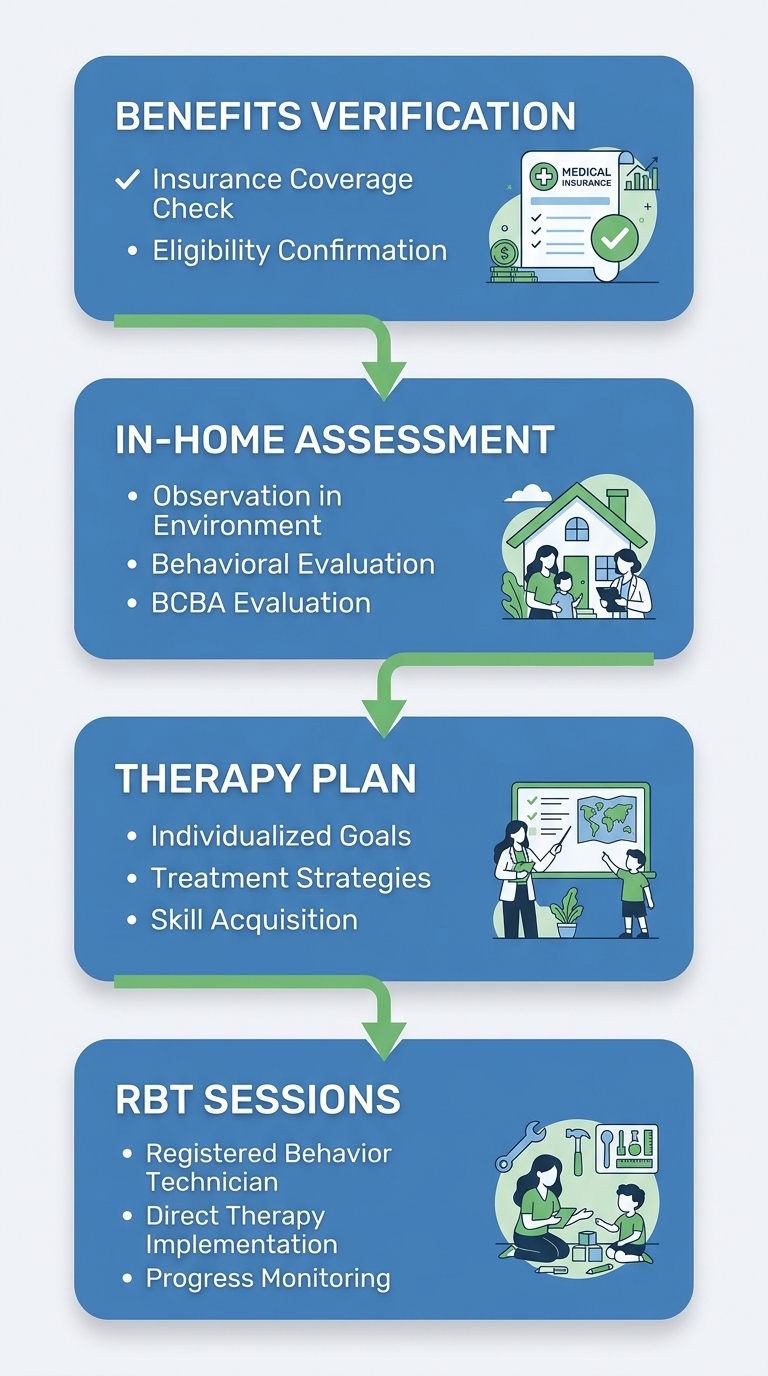
Heart Core ABA early intervention process in four steps
With this consistent, supervised approach, children start building communication, confidence, and independence, setting the stage for a future filled with meaningful connection and growth.
Best Practices for Implementing Early Intervention Strategies at Home and School
Implementing early intervention autism strategies 2026 at home and in school doesn’t have to feel overwhelming. At Heart Core ABA, we believe that parents and caregivers are the most powerful agents of change in a child’s life, and with the right support, daily moments become meaningful opportunities for growth. By blending evidence-based ABA principles with the warmth and consistency of family routines, we can create an environment where your child builds communication, confidence, and independence — because your child’s heart matters.
Embedding Strategies into Everyday Routines
One of the most effective approaches is natural environment teaching (NET), which uses a child’s daily activities to teach new skills in the settings where they naturally occur. Instead of sitting at a table for drills, learning happens during the moments you already share.
- Mealtime: Practice requesting (“more milk”), labeling foods, and making choices.
- Bath time: Target prepositions (“pour water on the cup”) and body parts.
- Playtime: Encourage turn-taking, joint attention, and imitation.
- Errands: Work on following directions, waiting, and safety skills in the community.
These bite-sized teaching opportunities add up quickly. When an RBT or a parent weaves a goal into a familiar routine, the skill becomes more functional and easier for a child to generalize across settings, whether at the kitchen table or in the school cafeteria.
Parent-Led Consistency: Making Intervention Stick
A parent-mediated intervention approach is most powerful when strategies remain consistent across all of a child’s environments. Children thrive on predictability, so using the same positive reinforcement, prompts, and expectations at home and at school reduces confusion and accelerates progress.
Here are a few ways to build consistency:
- Stay calm during challenging behaviors; your regulated presence teaches emotional co-regulation.
- Follow your child’s lead to increase engagement — join their play before introducing a new skill.
- Use praise that is specific and immediate: “Great job putting your shoes by the door!”
Remember, small steps lead to big changes. Our team is here to help you find the strategies that feel most natural for your family because every plan is personalized for your child’s success.
Partnering with Your BCBA and RBT Team
Collaboration between families and their clinical team is the foundation of effective early intervention. Your Board Certified Behavior Analyst (BCBA) designs and oversees a personalized therapy plan, while your Registered Behavior Technician (RBT) delivers the hands-on teaching during sessions, but your input as a parent is just as essential.
We encourage you to share observations, ask questions, and celebrate wins — no matter how small. It is essential to work with professionals who hold valid BACB certification ABA therapy, ensuring quality and ethical standards are upheld throughout your child’s care. According to the Behavior Analyst Certification Board (BACB), these credentials require rigorous training, supervision, and adherence to a professional ethics code. Regular team meetings are the perfect time to review data, adjust goals, and ensure everyone is working toward the same outcomes. When parents, RBTs, and BCBAs stay connected, progress becomes a shared journey.
Staying Informed: AI Screening and Research-Based Updates for 2026
As technology evolves, early intervention autism strategies 2026 increasingly include discussions around AI-powered screening tools. These digital resources are emerging as ways to flag developmental differences earlier, but they are not diagnostic instruments. We recommend viewing them as a starting point for a conversation with a qualified provider who knows your child personally.
When exploring new tools or therapies, we always encourage families to lean on research-backed approaches. The Interagency Autism Coordinating Committee (IACC) provides public guidance aligned with current scientific understanding, helping parents make informed decisions alongside their BCBA. By staying curious and partnering with certified professionals, you can navigate new developments with confidence, knowing that your child’s well-being remains the central focus of every decision.
Supporting Your Child’s Development Through Early Intervention
When researching early intervention autism strategies 2026, parents often wonder which approach best supports their child’s unique strengths. Once you recognize the value of early support, the next step is understanding which strategies work best for your child. The right method can build communication, confidence, and independence.
The table below compares three evidence-based early intervention approaches to help you choose the right path for your child.
| Approach | Primary Setting | Therapist Role | Parent Role | Key Benefit |
|---|---|---|---|---|
| Natural Environment Teaching (NET) | Home, playground, community | RBT incorporates learning into daily activities | Participate & extend learning moments | Generalizes skills across real-life situations |
| Parent-Mediated Intervention | Home and community | BCBA coaches parent as primary interventionist | Delivers strategies with BCBA support | Empowers family, increases consistency |
| Discrete Trial Training (DTT) | Structured table setting | RBT presents repeated trials in controlled environment | Observe and practice at home | Rapid acquisition of new skills |
At Heart Core ABA, we weave natural environment teaching into everyday moments, so your child learns through play and daily routines. With parent-mediated intervention, our BCBAs coach you to become your child’s primary teacher, empowering your family for lasting progress. For more structured skill-building, DTT offers focused, repeated practice. All three paths are evidence-based and personalized for your child’s success. We provide in-home early intervention in Kansas City, St. Louis, and across Missouri and Illinois, ensuring that real progress and real connection happen where your child feels most comfortable. For trusted, up-to-date information on early intervention, visit autism family health resources from the CDC.
Resources
- Discover the In-Home ABA Assessment Process
- Discover ABA and Special Education Trends for 2025-2026
- Discover ABA Strategies for Special Education Classrooms
- Advocate for ABA Therapy Inclusion in Your IEP
- Access CDC Health Resources for Autism Families
- Discover BACB Certification Requirements for Behavior Analysts
- Discover IACC Autism Research and Prevalence Data