Table of Contents
- Understanding Evidence-Based Autism Treatment in Springfield, Missouri
- Research-Backed ABA: The Gold Standard in Autism Care
- How ABA Therapy Improves Communication in Children with Autism
- Complementary Therapies: ESDM and Neurodiversity-Affirming Practices
- Why Doctors Recommend ABA Therapy After an Autism Diagnosis
- Your Path to Evidence-Based Care: Heart Core ABA's Approach
- Empowering Your Child's Progress with Evidence-Based Care
Understanding Evidence-Based Autism Treatment in Springfield, Missouri
When searching for evidence-based autism treatment in Springfield, Missouri, it helps to understand what that term really means. Evidence-based treatments are therapeutic approaches supported by rigorous scientific research and recognized as effective for autism spectrum disorder. They are built on proven methods that help children build communication, social, and daily living skills.
At Heart Core ABA, we provide personalized Applied Behavior Analysis (ABA) therapy in Springfield, offering in-home, school-based sessions. We deliver hands-on ABA therapy for children who learn differently, with every plan created and supervised by a Board Certified Behavior Analyst (BCBA). Our BCBAs are master’s-level clinicians certified by the Behavior Analyst Certification Board (BACB), and they lead a team of Registered Behavior Technicians (RBTs) who work directly with your child. Parent coaching is woven into our model so families can reinforce new skills at home. ABA is regarded as the gold standard of autism care, and our approach reflects that commitment to compassionate support.
Research-Backed ABA: The Gold Standard in Autism Care
When families in Springfield, Missouri, explore autism treatment, they quickly encounter Applied Behavior Analysis, or ABA. Considered the gold standard in autism care, ABA therapy is supported by extensive research and leading health organizations. Our entire approach at Heart Core ABA rests on this validated foundation, ensuring families receive care that is both compassionate and scientifically sound.
The Centers for Disease Control and Prevention (CDC) states that behavioral approaches, particularly ABA, have the most robust evidence for treating ASD symptoms. Their reviews place ABA-based strategies above other methods in measured effectiveness, a distinction based on decades of clinical study and consensus. The CDC also clarifies that medications do not treat core autism features, underscoring why high-quality behavioral therapy remains essential for children on the spectrum.
A peer-reviewed meta-analysis in Autism: The International Journal of Research and Practice, sourced through the Education Resources Information Center (ERIC), analyzed individual participant data from 491 children across 10 studies. Results showed that early, intensive ABA interventions led to greater improvements in adaptive behavior — a 7-point advantage on the Vineland Adaptive Behavior Scale — and cognitive ability, with a 14-point IQ advantage after two years compared to other treatment approaches. The meta-analysis focused on young children receiving early intensive behavioral intervention, a model our early intervention programs in Springfield closely follow.
We build directly on this evidence. Our BCBA-led teams deliver personalized, play-based ABA that matches proven research techniques with each child’s unique personality and strengths. We work with families in Springfield and across Missouri, turning rigorous findings into real, observable growth in communication, social skills, and independence. By choosing ABA grounded in this level of evidence, Missouri families give their children access to strategies with measurable, lasting benefits. Our parent coaching sessions also make sure that learning continues beyond therapy hours, embedding new skills into daily life.
For the children we work with, the proof of ABA’s effectiveness shows up in everyday moments — a first spoken word, a successful turn during play, a calm transition between activities. These milestones of real progress emerge time and again when evidence-based techniques meet consistent, caring implementation from our therapy team.
How ABA Therapy Improves Communication in Children with Autism
Because ABA therapy is grounded in proven principles of learning and behavior, it offers a clear pathway to building communication skills in children with autism. At Heart Core ABA, we see daily how targeted reinforcement and natural teaching moments help children find their voices—and build real connections with the people around them.
When a child attempts to communicate, whether through a gesture, a sound, or a word—we deliver an immediate, meaningful reward. Honoring that attempt might mean providing the requested toy or sharing a favorite snack right away, pairing the child’s effort with a positive outcome.
- Differential Reinforcement: We reinforce a more appropriate communication alternative (e.g., prompting a child to say “water” instead of crying and rewarding the new behavior immediately).
- Token Economy Systems: Children earn tokens for each communication attempt, trading them for a larger reward, which sustains motivation during longer practice sessions.
- first-then boards: A simple visual schedule (“First communication, Then reward”) gives predictability and a clear incentive to use words or pictures.
Natural Environment Teaching (NET) brings these reinforcement strategies into the moments children already love. During snack time, a therapist might model the word “cracker” and reward the child’s attempt. This is manding, the skill of requesting. When a child spontaneously labels a color or shape during play, that’s tacting—labeling objects and experiences in the moment. By embedding communication targets into feeding, bath time, and family games, NET ensures that skills are practiced in context, making them automatic and meaningful for the child.
Through parent coaching, we teach caregivers to use these same techniques consistently throughout the day, because communication skills thrive when every adult responds in a similar way. Consistency across home and school helps children generalize what they learn, turning practiced exchanges into real connection with family and friends. Our Board Certified Behavior Analysts (BCBAs) oversee each plan, customizing strategies to the child’s interests and adjusting as the child’s confidence grows.
These evidence-backed methods open the door to richer, two-way communication. When combined with complementary, neurodiversity-affirming practices, the foundation for connection becomes even stronger—honoring each child’s unique way of interacting with the world.
Complementary Therapies: ESDM and Neurodiversity-Affirming Practices
While ABA therapy lays the groundwork for developing communication and social skills, complementary approaches like the Early Start Denver Model (ESDM) take that foundation further by blending developmental science with behavioral strategies.
ESDM is recognized as the first comprehensive, empirically validated intervention designed specifically for toddlers and preschoolers on the autism spectrum. According to the Education Resources Information Center (ERIC), the seminal ESDM manual integrates principles from developmental psychology and applied behavior analysis, creating a play-based, relationship-focused framework that targets critical social and communication milestones. This model includes a detailed fidelity rating system, allowing clinicians to monitor and maintain high-quality implementation. ESDM is tailored for children in the toddler and preschool age range (typically 18 to 48 months) and emphasizes joy, shared engagement, and natural learning opportunities—elements that align beautifully with our own philosophy of care.
Because ESDM builds on the same behavioral foundations as traditional ABA while infusing developmentally appropriate, child-led interactions, it serves as a natural complement to the structured skill-building often associated with ABA therapy. In our practice, we see how blending these approaches helps children generalize skills and respond with greater enthusiasm.
Beyond ESDM, neurodiversity-affirming practices further reinforce this child-centered direction. These practices prioritize respect for each child’s neurotype and emphasize learning through natural, self-directed play rather than compliance-based routines. Natural Environment Teaching (NET) is one such strategy that we use: it embeds skill instruction into a child’s favorite activities and daily routines, using natural consequences instead of tokens or external rewards. NET captures a child’s intrinsic motivation and makes therapy feel less like work and more like exploration. Similarly, our RBT sessions deliver one-on-one, play-based intervention under the careful supervision of a BCBA. With each RBT receiving supervision for at least 5% of their therapy hours, these sessions maintain treatment integrity while staying responsive to the child’s current interests and fully aligned with neurodiversity-affirming values.
These complementary, scientifically grounded methods—with their emphasis on natural play, relationship, and respect—are a big part of why professionals often recommend ABA therapy following a formal autism diagnosis. They show that effective treatment can be both rigorous and deeply honoring of who a child truly is.
Why Doctors Recommend ABA Therapy After an Autism Diagnosis
While developmental and play-based therapies offer valuable support, the strongest evidence—according to the Centers for Disease Control and Prevention—points to behavioral approaches like Applied Behavior Analysis. The CDC classifies these interventions as having the most robust evidence among autism treatments, particularly for improving communication, social skills, and adaptive behavior. For families navigating an autism diagnosis, this broad scientific consensus provides reassurance that ABA is a well-supported step forward. This evidence-based foundation is why doctors routinely refer families to ABA therapy after an autism diagnosis.
A meta-analysis published by the U.S. Department of Education examined individual data from 491 children across ten international studies. After two years of early intensive ABA, children showed statistically significant gains in adaptive behavior and cognitive ability compared to those receiving standard interventions. On the Vineland Adaptive Behavior Scale, the average improvement was 7 points, while cognitive scores rose by an average of 14 points. These quantitative gains translate into real progress—better communication, self-care, and learning readiness. They also help physicians feel confident that recommending ABA is grounded in rigorous science, not anecdote. For families, this data offers a concrete picture of the gains children can achieve with sustained, high-quality ABA.
Research in educational settings further supports this evidence. A randomized controlled trial reviewed by the Institute of Education Sciences evaluated the Center on Secondary Education for Students with Autism (CSESA) model across 59 high schools. The study found that schools implementing CSESA—which trains multidisciplinary teams to improve instruction, social supports, and transition planning—showed significantly better school climate and enhanced student outcomes in communication and independence. This real-world success in school settings further validates the broad applicability of behaviorally based strategies. These findings demonstrate that evidence-based behavioral principles work not only in clinical environments but also in the classroom, helping students thrive across the settings where they learn and grow.
This research foundation is what drives the therapy model we implement every day. We turn proven methods into a personalized therapy plan that fits each child’s unique strengths and goals.
Your Path to Evidence-Based Care: Heart Core ABA’s Approach
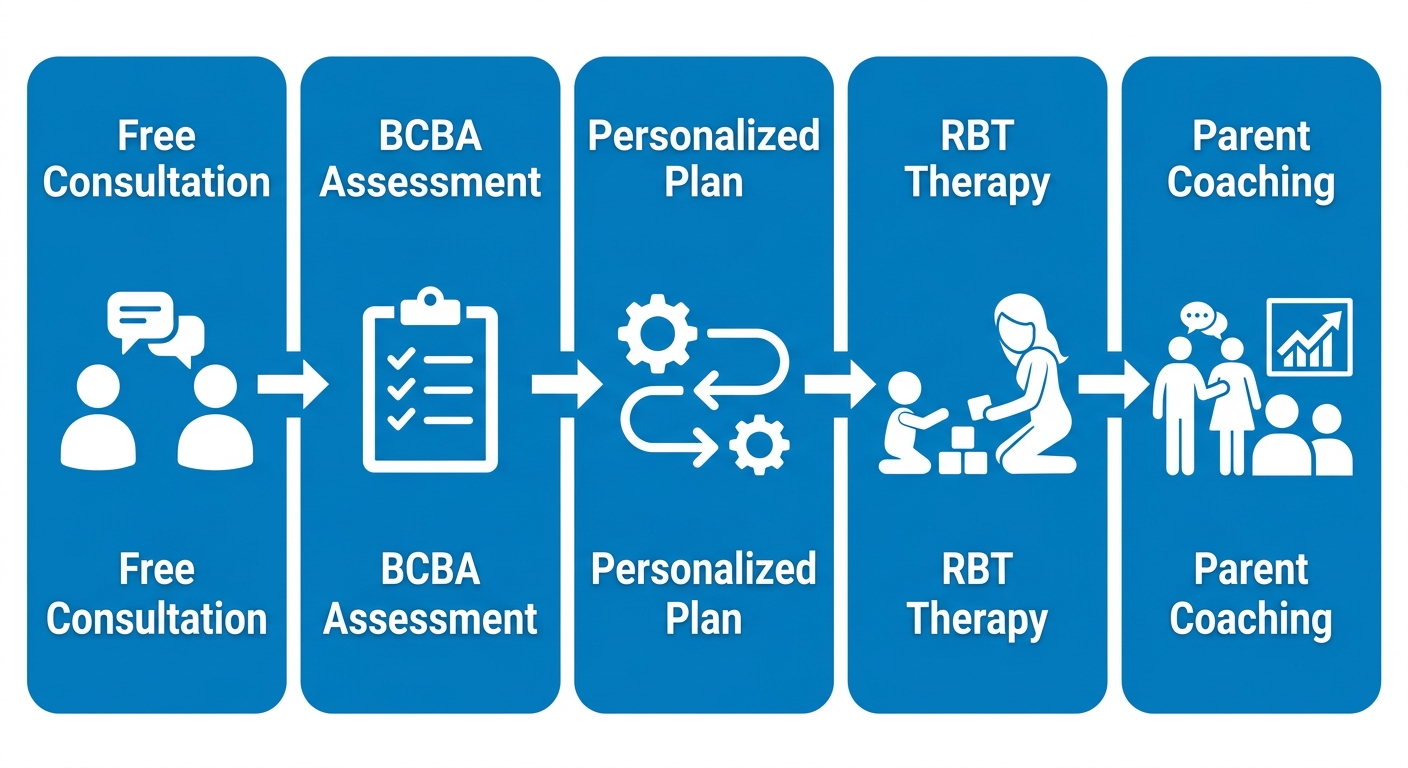
A recommendation for ABA is the first step. Here is how we put that into practice through our evidence-based approach. We guide you through a clear, structured path designed to feel supportive from the very first conversation.
Our process begins with a free consultation and insurance verification, so you understand your benefits before making any commitments. A Board Certified Behavior Analyst (BCBA) — a master’s-level clinician certified by the Behavior Analyst Certification Board — then conducts a comprehensive assessment of your child’s strengths and needs. This evaluation becomes the foundation for a personalized therapy plan targeting real-life skills like communication, daily routines, and social interaction.
Our BCBAs incorporate clinically proven methods into every plan, drawing from techniques with strong research support. These include Differential Reinforcement of Alternative Behavior, which strengthens desired behaviors by rewarding them consistently, and Token Economy Systems that help children visualize progress toward meaningful incentives. Natural Environment Teaching weaves learning opportunities into everyday moments — mealtime, play, and family routines — so skills develop in the contexts where they matter most.
Parent coaching stands as a core component of our approach. Our BCBAs teach families proactive behavioral strategies to reinforce skills at home and in the community, distinguishing between genuine reinforcement and reactive responses. Visual tools like first-then boards give children a clear way to understand expectations and communicate their needs effectively, building confidence and independence.
Trained Registered Behavior Technicians deliver therapy sessions under ongoing BCBA supervision, with weekly progress updates keeping families informed every step of the way. Whether services take place in your home, at school, or in one of our centers across Missouri — including Springfield, St. Louis, and Kansas City — our teams work consistently to support your child’s development. This comprehensive, research-backed therapy approach sets the stage for each child’s ongoing growth, and children discover their own capacity for progress.
Heart Core ABA partners with families to make evidence-based strategies a natural part of daily life, so the skills gained in therapy translate into lasting, meaningful change.
Empowering Your Child’s Progress with Evidence-Based Care
We’ve shared how we combine evidence-based methods with personalized, play-based care to support your child’s development. From the first phone call, we verify your insurance benefits and handle prior authorizations. A BCBA then conducts a home assessment and outlines a tailored plan, while our RBTs provide one-on-one therapy in the setting that works best for your family—at home, at school, or in a center. Throughout the process, weekly updates and parent coaching help you stay connected.
While every child’s journey is unique and results may vary, our heart-centered, data-driven approach gives you actionable insights you can trust. Remember that this information is not a substitute for professional medical advice; consult a healthcare professional for diagnosis and treatment. We also recommend verifying your insurance coverage, as prior authorization may be required. We invite you to reach out for a free assessment. Together, we can build a path forward with evidence-based autism treatment that empowers your child.
Start Your Free Assessment Today
Understanding evidence-based autism treatment is the first step toward empowering your child’s communication and daily living skills. Our BCBA-designed therapy plans incorporate research-backed methods like positive reinforcement and natural environment teaching to foster real progress. With personalized, in-home, school-based, and center-based sessions, your child receives consistent support across environments. Parent coaching ensures that the skills learned in therapy are reinforced at home, building a strong foundation for lifelong growth. The team at Heart Core ABA guides you through a straightforward onboarding process, including free insurance verification and a no-obligation consultation. Take the next step by reaching out to learn more about how evidence-based ABA therapy can make a difference for your family. Discover the difference compassionate, hands-on care can make for children who learn differently.
Start Your Free Assessment Today