Table of Contents
- ABA Trends 2026 in the United States: What Families Need to Know
- The Fundamentals of ABA Therapy in 2026
- Exploring 2026 ABA Trends: AI, Telehealth, and Workforce Shifts
- Practical Applications of ABA Trends for Families and Providers
- Advanced Developments in ABA Therapy: Personalization and Ethics
- Common Questions About ABA Trends in 2026
- Navigating ABA Therapy in 2026 and Beyond
ABA Trends 2026 in the United States: What Families Need to Know
In 2026, families across the U.S. are looking at the most impactful aba trends 2026 to guide therapy decisions. At Heart Core ABA, we blend hands-on care with innovation to support your child’s growth.
One of the most talked-about aba trends 2026 is the integration of ai in aba therapy. AI tools help Board Certified Behavior Analysts analyze data and suggest tailored interventions. We at Heart Core ABA use AI-assisted progress tracking to refine personalized therapy plans. This data-driven approach lets our BCBAs make swift adjustments that accelerate progress.
Telehealth aba therapy is expanding, offering parent coaching and remote supervision for busy families. Our remote parent coaching sessions let caregivers learn strategies and connect with BCBAs from home, complementing in-person support. These virtual sessions reinforce skills between visits and make therapy more flexible.
Early intervention remains essential, with the Centers for Disease Control and Prevention reporting that 1 in 36 children are identified with autism spectrum disorder. Research shows that early, intensive ABA can lead to significant gains in language, social, and adaptive behaviors. Starting therapy before age three, as highlighted by CDC Autism Early Intervention guidance, builds foundational communication skills. Our early intervention program offers play-based, BCBA-led sessions tailored to toddlers.
Heart Core ABA stays dedicated to Real progress, real connection, and care that comes straight from the heart. Reach out to explore our in-home, school-based, and center-based services and discover a personalized therapy plan for your child. Results may vary. Verify insurance coverage and consult a healthcare professional for diagnosis.
The Fundamentals of ABA Therapy in 2026
The field of Applied Behavior Analysis (ABA) has transformed dramatically heading into 2026, moving beyond the rigid, clinic-only structures of the past. At Heart Core ABA, we’ve integrated technology, flexible scheduling, and deeper family collaboration to meet the needs of families in Springfield, MO, and across Missouri. These aba trends 2026 reflect a shift toward more accessible, personalized care that meets children where they are.
To see how far we’ve come, here’s a comparison of traditional ABA delivery from 2010-2020 and the 2026 model we follow today:
| Aspect | Traditional ABA | 2026 ABA |
|---|---|---|
| Therapy setting | Clinic‑based only | Home, school, clinic, telehealth |
| Data collection method | Pen‑and‑paper, manual graphs | AI‑driven apps, real‑time dashboards |
| Parent involvement | Monthly meetings | Weekly video coaching, 24/7 portal |
| Session frequency | Fixed 1:1 schedules | Flexible hybrid schedules |
These shifts mean therapy no longer happens in isolation. By meeting children in their natural environments and giving parents continuous visibility, we can adapt strategies on the fly—something the 2026 model enables through AI-powered tracking and hybrid sessions. This evolution represents more than just convenience; it creates a support system that grows with each family’s unique rhythm.
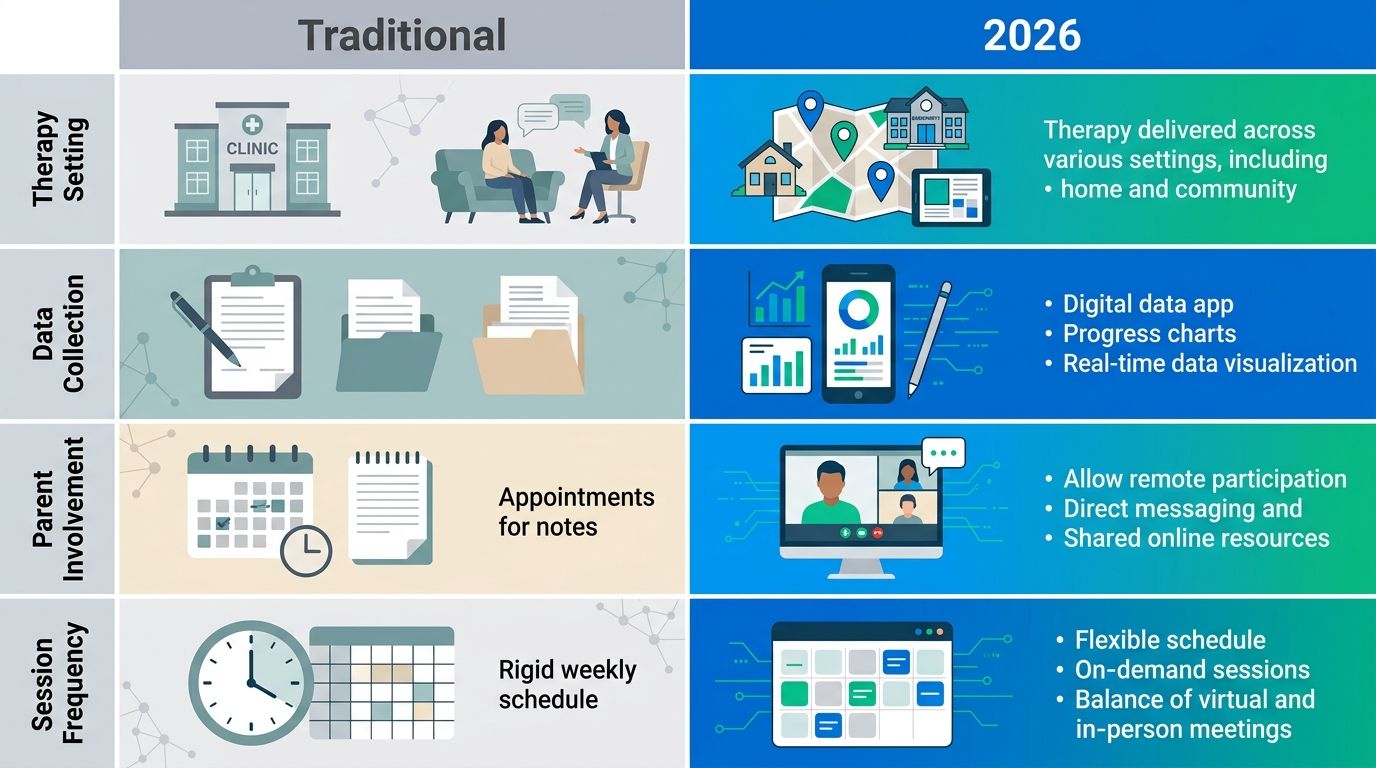
Traditional vs modern ABA therapy comparison infographic
One of the most visible changes in 2026 is where therapy happens. telehealth aba therapy now complements in-home and school sessions, giving families in Columbia, St. Louis, and beyond the flexibility to connect with their BCBA even when travel isn’t possible. Whether we’re working side-by-side in a child’s classroom or coaching parents through a secure video call, our goal is consistent, real-world skill building.
Technology also powers the way we track progress. ai in aba therapy enables real-time dashboards that replace stacks of paper graphs, so our clinicians can spot patterns instantly and adjust interventions the same day. This data-driven approach supports more responsive, individualized sessions, though it’s the human connection—our BCBAs working closely with RBTs and families—that drives meaningful outcomes. This aligns with updated certification standards from the Behavior Analyst Certification Board (BACB), ensuring that ABA in 2026 is both innovative and grounded in evidence.
Parent involvement has evolved from occasional meetings to a continuous partnership. Through weekly video coaching and a 24/7 portal, caregivers in our in-home and center-based programs stay engaged and confident. Flexible session scheduling—mixing in-person and remote—lets us design a rhythm that respects each family’s daily life rather than asking them to fit into a rigid clinic calendar. These aba trends 2026 show that modern ABA is as much about family empowerment as it is about clinical technique.
Behind every modern ABA plan is a Board Certified Behavior Analyst who translates these principles into action. Our team’s BCBAs combine the latest research with genuine care, creating personalized therapy plans that treat the whole family. For a deeper look at what it takes to become a board certified behavior analyst in 2026, explore our complete career guide.
Exploring 2026 ABA Trends: AI, Telehealth, and Workforce Shifts
AI-Enhanced Data Collection and Personalization
Among the most exciting aba trends 2026 is the rise of AI-enhanced data collection in ABA therapy. AI tools now enable real-time behavior capture, drastically reducing the paperwork burden for Registered Behavior Technicians (RBTs) and Board Certified Behavior Analysts (BCBAs). Industry reports show that 65% of clinics have adopted AI data tracking platforms this year, while 40% of BCBAs use AI personalized learning algorithms daily to tailor reinforcement schedules. This ai in aba therapy shift allows us to create highly personalized therapy plans that adapt to each child’s unique pace and preferences, leading to better engagement and faster skill acquisition. At Heart Core ABA, we use these tools to support our team in delivering hands-on ABA therapy for children who learn differently across Springfield, MO and surrounding areas. By automating routine tracking, AI frees RBTs to dedicate more time to direct, meaningful interactions with children. This not only improves data accuracy but also strengthens the real connection between therapist and child, helping us achieve real progress every day while easing workforce pressures.
Telehealth ABA: Effectiveness and Access
Telehealth aba therapy has transformed service delivery by extending high-quality ABA to families who might otherwise struggle with travel time, caregiver schedules, or limited local providers. Recent studies indicate that many telehealth interventions yield outcomes comparable to in-person therapy for skill acquisition and parent training. For Heart Core ABA, this means we can offer consistent, hands-on support to families in rural parts of Missouri and beyond, reducing session cancellations and fostering stronger parent engagement. The following table highlights key AI and telehealth tools shaping practice in 2026:
| Tool/Approach | Primary Use | Adoption Rate (2026) | Key Benefit |
|---|---|---|---|
| AI data tracking platforms | Real‑time behavior capture and analysis | 65% of clinics | Accurate, less paperwork |
| Telehealth video sessions | Remote 1:1 and parent training | 50% of families offered hybrid | Convenience, access to specialists |
| AI personalized learning algorithms | Tailored reinforcement schedules | 40% of BCBAs use daily | Better engagement, faster skill acquisition |
These tools empower our BCBAs and RBTs to provide real progress and real connection, whether in person or via secure video. By blending AI-driven personalization with telehealth, we deliver truly personalized therapy plans that adapt in real time, making every session count. Families appreciate the convenience and the ability to participate in their child’s therapy from the comfort of home, and we continue to see strong clinical outcomes through this blended model. Results may vary, and it’s important to consult a healthcare professional for diagnosis and treatment.
Regulatory Landscape for Telehealth in 2026
The regulatory environment for telehealth ABA in 2026 continues to evolve, with Medicaid flexibility being a cornerstone of expanded access. The Centers for Medicare & Medicaid Services (CMS) have updated prior authorization requirements and enhanced support for state-level telehealth programs, making it easier for families to receive services like ours. We help families stay informed about medicaid telehealth aba therapy coverage changes to ensure they benefit from available options. Providers must also remain vigilant about HIPAA compliance and data privacy as more tools go digital. For families seeking personalized therapy plans through telehealth, we recommend verifying insurance coverage, as prior authorization may be required. At Heart Core ABA, we see these updates as opportunities to strengthen our commitment to care that comes straight from the heart, reaching more children in Springfield and across Missouri with consistent, high-quality interventions. Looking ahead, we anticipate continued integration of AI and telehealth, with regulations adapting to support evidence-based practice and protect client data. As these trends accelerate, we remain dedicated to offering hands-on ABA therapy for children who learn differently, guided by data and delivered with heart. Information on this site is not a substitute for professional medical advice.
Practical Applications of ABA Trends for Families and Providers
When we look at aba trends 2026, three practical shifts stand out for families and providers: integrating AI tools meaningfully into home routines, setting up effective telehealth services, and building reliable therapy teams despite workforce changes. These aren’t distant predictions. They represent real opportunities you can act on today, and our team at Heart Core ABA is committed to helping you navigate each one with confidence. By combining compassionate care with forward-thinking tools, we ensure your child benefits from the best that modern ABA therapy has to offer.
Integrating AI Tools into In-Home ABA Therapy
One major trend is the rise of ai in aba therapy, and it is reshaping how families practice skills between sessions. At Heart Core ABA, our personalized aba therapy ensures that AI tools enhance, not replace, the human connection. To get started, choose a child-friendly app designed specifically for ABA data collection, one that tracks behaviors like requesting items or making eye contact without turning learning into a passive screen experience. Once you have selected a tool, we help you set up a shared data dashboard. This allows your BCBA to see progress between visits, adjust goals faster, and celebrate wins with you in real time.
Maintaining a natural, play-based environment is essential. We recommend limiting screen-based activities to roughly ten minutes per segment and weaving the AI tool into games your child already enjoys. For example, tracking turn-taking during a board game or naming emotions while reading a story keeps the interaction developmentally appropriate. Each week, the AI tool generates a simple progress report. During supervision sessions, your BCBA reviews these insights alongside direct observations, creating a richer picture of your child’s growth.
The following table compares delivery models available to families in 2026, helping you decide which approach fits your daily life and your child’s needs best.
| Model | Best For | Technology Required | Typical Session Mix |
|---|---|---|---|
| Pure In‑Home | Families wanting no travel | Tablet with ABA app | 100% in‑home 1:1 |
| Center‑Based + Telehealth | Social skill building + remote coaching | Video platform, behavior tracking software | 3 days center, 2 days telehealth |
| Hybrid In‑Home & Telehealth | Max flexibility, rural access | Secure telehealth, RBT‑supported home visits | 2 in‑home + 3 telehealth per week |
Each model in the table represents a pathway we actively support for families in Springfield and across Missouri. The Pure In-Home option works beautifully for young children who thrive in familiar settings, while Center-Based and Hybrid models offer richer peer interaction. Your BCBA will help you weigh these choices against your child’s individual goals, ensuring the technology serves the therapy rather than the other way around.
Navigating Telehealth ABA Services for Your Child
Setting up telehealth aba therapy requires a few key ingredients, but the process is simpler than many families expect. You will need a tablet or laptop with a working camera, a stable Wi-Fi connection, and a quiet corner of your home where your child feels comfortable. For younger children, a parent or caregiver should remain present to help with redirection and to practice the techniques alongside the RBT.
We know that attention spans can feel like the biggest barrier. Our team structures remote sessions in short, engaging blocks, often starting with just fifteen minutes of focused interaction and gradually building stamina. If technology glitches happen, which they occasionally do, we recommend testing your connection a few minutes before the scheduled start time. Our RBTs will coach you through the first few sessions until you feel confident managing the setup independently. In our experience serving families in Springfield and throughout Missouri, this gradual onboarding transforms telehealth from an intimidating experiment into a natural part of the weekly routine.
Workforce Trends: Finding and Retaining Skilled Therapists
Workforce changes are another critical piece of the aba trends 2026 picture. Updated BACB continuing education requirements and RBT renewal standards mean that credentialing is becoming more rigorous, a positive shift for quality of care but one that also places pressure on provider availability. To retain skilled therapists, agencies must invest in consistent scheduling, paid training opportunities, and thoughtful matching between families and clinical teams.
At Heart Core ABA, our team of 42 BCBAs and 54 RBTs works to provide consistent, long-term matches for your child. We believe that stable relationships drive real progress. That is why we prioritize reasonable caseloads, ongoing professional development, and regular check-ins with both families and staff. While no provider can guarantee that a specific therapist will remain available indefinitely, our commitment to continuity means we build deep benches and cross-train team members so that transitions, when they occur, are smooth and minimally disruptive.
For families seeking consistent care, we recommend asking providers about their retention rates, caseload policies, and therapist matching process. Our team in Springfield handles all of these details so you can focus on celebrating your child’s achievements. By staying ahead of workforce trends, we make sure that real progress and real connection remain at the center of everything we do.
Results may vary.
Advanced Developments in ABA Therapy: Personalization and Ethics
As we look ahead to aba trends 2026, personalization and ethics are reshaping how ABA therapy is delivered. Advanced technologies and oversight enable us to craft interventions uniquely suited to each child. Building on core ABA principles, these developments tailor therapy through AI and ethical frameworks, creating responsive care that honors every family’s journey. Our team embraces this evolution with compassion and expertise.
Here’s a quick look at how different AI approaches compare:
| Approach | Customization Level | Ethical Considerations | Implementation Readiness |
|---|---|---|---|
| Rule‑based algorithms | Medium | Low bias risk, but rigid | High – already in use |
| Machine learning models | High | Requires data privacy safeguards | Medium – growing adoption |
| Human‑guided AI (BCBA oversight) | Very High | Best balance of personalization & ethics | High – recommended model |
Rule-based algorithms use predefined protocols to personalize therapy, such as if-then decision trees that adjust prompts based on responses. While they provide medium customization and low bias risk, their rigidity limits adaptability when needs shift quickly. This approach is already in use across many ABA settings and offers a reliable foundation for families who benefit from structured, consistent routines. Many clinics find this method helpful for initial skill acquisition.
Machine learning models go deeper by analyzing large datasets to identify patterns and tailor interventions with high precision. This dynamic approach can adapt in real time as new data emerges, but it requires strong data privacy safeguards to protect sensitive information. Adoption of ai in aba therapy through these models is medium yet growing, as providers balance innovation with safety. Ensuring confidentiality remains a top priority for us.
We recommend human-guided AI—where a BCBA oversees every adaptation—because it merges advanced technology with clinical judgment. This model achieves very high customization while upholding ethical integrity, resulting in a truly Personalized therapy plan. AI also supports telehealth aba therapy by adjusting interventions in real time during remote sessions, expanding access across Missouri. With BCBA oversight, every decision stays safe and evidence-based. This approach aligns with our commitment to care that comes straight from the heart.
These personalization and ethics advancements set the stage for the next generation of ABA therapy. The Behavior Analyst Certification Board (BACB) regularly issues BACB certification updates 2026, setting clear standards for responsible AI integration. At Heart Core ABA, we ground our practice in these ethical guidelines to deliver Real progress, real connection. Results may vary.
Common Questions About ABA Trends in 2026
Parents often ask us about what these changes mean. Here are common questions about ABA trends in 2026.
- What are the top ABA trends in 2026? We see three key shifts: the integration of AI in ABA therapy for data collection and personalized plans, the growth of telehealth ABA therapy expanding access to rural families in Missouri, including Springfield, and the evolution of social skills groups using video modeling and small-group telepractice.
- Are social skills groups still relevant in 2026? Absolutely! Our social skills groups remain a cornerstone of personalized therapy plans, now enhanced with technology. Through age-matched small groups, children practice turn-taking, conversation skills, and problem-solving in supportive environments led by our BCBAs. A HeartCore ABA resource describes these groups as a way to turn abstract social expectations into concrete, actionable behaviors.
These emerging ABA trends in 2026 help us deliver real progress, real connection. To explore how these trends can shape your child’s personalized therapy plan, contact us for a consultation. Results may vary. Consult a healthcare professional for diagnosis and treatment.
Navigating ABA Therapy in 2026 and Beyond
As we look at aba trends 2026, technology is reshaping ABA. ai in aba therapy is improving data analysis, and telehealth aba therapy is expanding remote sessions. Our board certified behavior analyst leads these innovations, integrating AI and telehealth into personalized plans that ensure data-driven, effective care.
At Heart Core ABA, we embrace these changes while staying true to our hands-on, play-based approach that creates real progress, real connection. We’re committed to delivering care that comes straight from the heart, using every tool to help your child thrive with compassion.