Table of Contents
- Understanding RBT Sessions for Autism Therapy
- The Role of a Registered Behavior Technician (RBT) in ABA Therapy
- How RBT Sessions Are Structured and Supervised
- Determining RBT Session Frequency, Cost, and Settings
- Best Practices for Maximizing Progress with RBT Sessions
- Frequently Asked Questions About RBT Sessions
- Supporting Your Child with RBT Sessions
Understanding RBT Sessions for Autism Therapy
RBT sessions for autism are the direct, one-on-one therapy time that makes ABA come alive for your child. A Registered Behavior Technician works under the careful supervision of a BCBA, practicing communication, social, and daily living skills in each session. Our RBTs use evidence-based strategies to help your child learn in natural, motivating ways, always building on your child’s unique strengths.
When sessions take place in your home, therapy is woven into familiar routines, which helps your child transfer new skills to everyday life. After an autism diagnosis in Missouri, families can quickly begin in-home RBT sessions, reducing wait times and making it easier for you to participate in the process. Our team brings the therapy to you, turning your living room or kitchen into a space for real growth. We also model strategies for caregivers during sessions.
Every RBT session is guided by a personalized plan created by a BCBA, evolving as your child masters new goals. We share weekly parent updates, so you’re always informed about progress and next steps. We coach caregivers to practice skills daily. This hands-on ABA therapy is personalized for your child’s success, fostering real progress, real connection, and the confidence that comes with lasting independence.
The Role of a Registered Behavior Technician (RBT) in ABA Therapy
When we begin ABA therapy, a Registered Behavior Technician, or RBT, is often the professional your family will spend the most time with. RBTs are the passionate clinicians who deliver hands-on ABA therapy with warmth and consistency, making them central to your child’s progress. At Heart Core ABA, our RBTs conduct personalized rbt sessions for autism that turn your child’s unique goals into achievable, everyday moments, all while working closely under the careful guidance of a Board Certified Behavior Analyst.
What an RBT Does During Therapy
The core of an RBT’s work happens during vibrant, one-on-one therapy sessions. We design these sessions to be entirely Personalized for your child’s success, whether the focus is on communication, play, or building daily routines. Throughout these RBT-led sessions in Missouri, our team skillfully implements the strategies your BCBA has mapped out in the treatment plan. A key part of this involves systematically collecting detailed data on every skill practiced. This real-time information allows for constant adjustments to the therapy, ensuring your child is always engaged in a program that fosters Real progress, real connection. The role is entirely hands-on and heart-centered, as RBTs work to build trust and confidence through positive reinforcement, creating a safe space for your child to learn and thrive.
The Path to Becoming a Registered Behavior Technician
We believe you deserve to know the high standards behind the certification of the clinicians in your home. To become an RBT, an individual must meet rigorous requirements set forth by the Behavior Analyst Certification Board (BACB). The path begins with completing a comprehensive 40-hour training program that covers the fundamentals of ABA. After the training, the candidate must pass a detailed competency assessment conducted by a BCBA, demonstrating their skills in real-world scenarios. This entire process leads to the official behavior analyst certification, which is a milestone that signifies a commitment to ethical, evidence-based care. But the learning doesn’t stop there; every RBT is required to receive ongoing supervision for a minimum of 5% of all direct therapy hours and regularly renew their certification, ensuring their skills remain sharp and current.
How the RBT Fits into Your Child’s Care Team
A successful therapy journey is a true partnership, where each person on the care team plays a clear and distinct role. The table below compares the roles of an RBT, BCBA, and parent/caregiver, showing exactly how we work together to support your child.
This structure clearly illustrates how your BCBA leads the team by designing a comprehensive strategy, while your RBT is the direct therapist who builds a one-on-one connection with your child in every single session. As parents and caregivers, your role is vital for continuity; by learning and applying strategies at home through our coaching sessions, you make progress a natural part of your family’s daily rhythm.
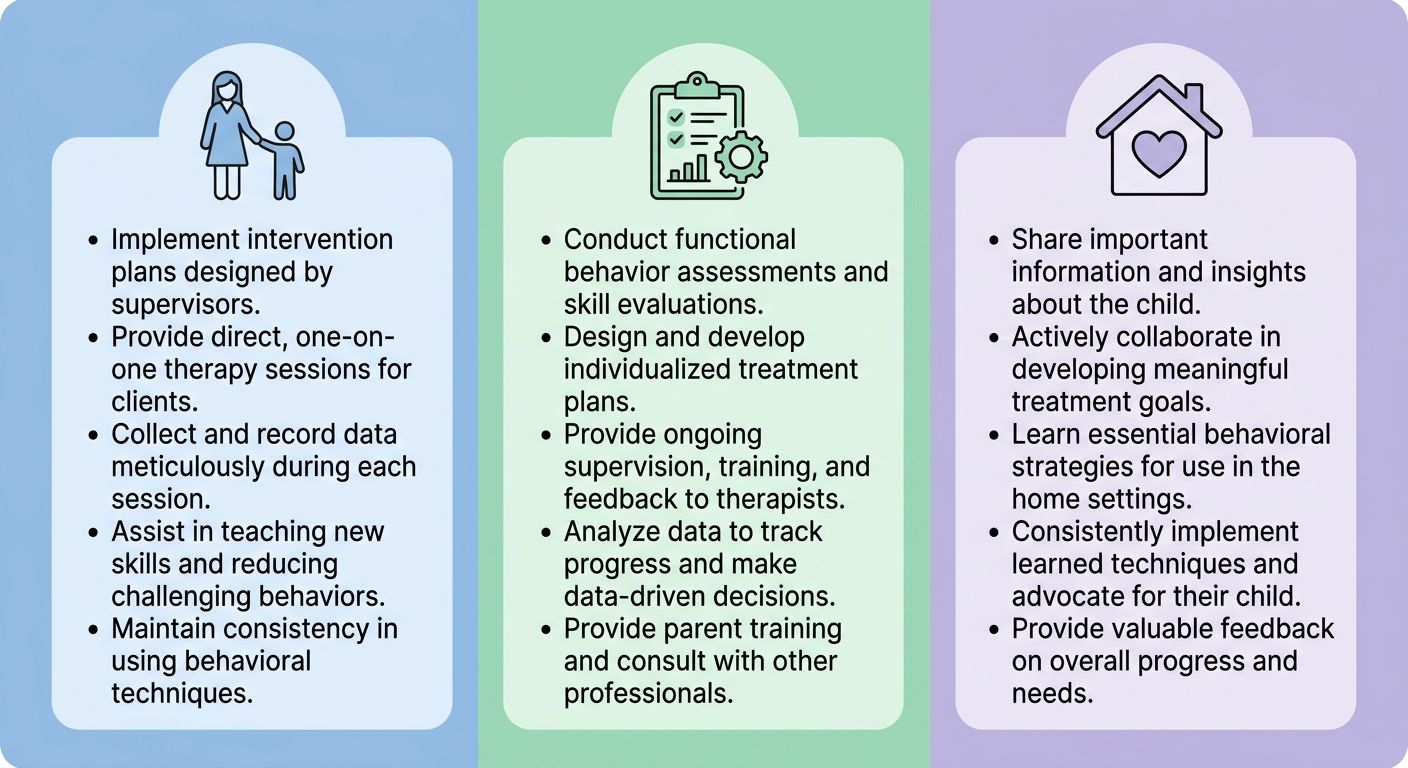
RBT, BCBA, and parent roles in ABA therapy
How RBT Sessions Are Structured and Supervised
Now that you know who your child’s RBT is, let’s walk through what a typical session looks like and how it’s supervised. Understanding how RBT sessions for autism are structured helps parents feel confident. If your child has received an autism diagnosis in Missouri, our RBT sessions are designed to build communication, confidence, and independence from the start.
Structure of a Typical RBT Session
A typical in-home RBT session at Heart Core ABA follows a predictable, nurturing rhythm that balances play and structured learning. Every session begins with pairing—a rapport-building phase where the RBT engages your child in preferred activities. Once a positive connection is established, the therapist introduces discrete trial training (DTT), a teaching method that breaks skills into small, manageable steps. Throughout the session, the RBT also uses natural environment teaching (NET), embedding skill practice into your child’s everyday routines. While the session unfolds, the RBT discretely collects trial-by-trial data on an electronic device.
BCBA Supervision: Direct vs. Indirect Oversight
At Heart Core ABA, every RBT is backed by a BCBA who provides both direct and indirect supervision. Direct supervision involves the BCBA observing therapy sessions in real time to monitor the RBT’s implementation of the treatment plan. Indirect supervision includes weekly or biweekly data review meetings where the BCBA analyzes your child’s progress graphs and adjusts the therapy plan.
| Role | Responsibilities | Training Requirements | Supervision Level |
|---|---|---|---|
| Registered Behavior Technician (RBT) | Delivers 1:1 ABA therapy sessions, implements skill-building plans, collects data. | 40-hour training, competency assessment, BACB certification. | Direct supervision by BCBA (min 5%) |
| Board Certified Behavior Analyst (BCBA) | Conducts assessments, develops treatment plans, supervises RBTs. | Master’s degree, supervised fieldwork, BCBA exam. | Supervises RBTs and oversees care |
| Parent/Caregiver | Reinforces skills at home, participates in parent coaching. | Parent coaching sessions | Guided by BCBA and RBT |
Data Collection and Progress Tracking
Data collection is at the heart of every RBT session. RBTs record each learning trial in real time using secure software. At Heart Core ABA, our BCBAs review this data to identify patterns of skill acquisition and adjust teaching strategies. We provide weekly parent updates that include session summaries and visual progress graphs.
Determining RBT Session Frequency, Cost, and Settings
Deciding on the appropriate number of rbt sessions for autism is a deeply personal process. At Heart Core ABA, we create personalized recommendations because your child’s success is not a one-size-fits-all formula.
How Many RBT Sessions Per Week Does a Child Need?
| Supervision Type | Frequency | Purpose | Examples |
|---|---|---|---|
| Direct Supervision | At least 5% of RBT session hours monthly | Observe RBT implementation, provide real-time feedback. | BCBA observes a session in-home. |
| Indirect Supervision | Ongoing, scheduled weekly/biweekly | Review data, adjust treatment plans. | Weekly BCBA-RBT meeting. |
Average Hourly Rate for RBT Services in Missouri
The average hourly rate for one-on-one RBT sessions in Missouri typically falls between $40 and $60 per hour. Many insurance plans require a formal autism diagnosis in Missouri to qualify for coverage. We offer a free insurance benefits verification process to help you understand your options.
RBT Sessions in Schools and Daycare Settings
We bring hands-on ABA therapy directly into your child’s school or daycare. Our RBTs collaborate closely with teachers to integrate behavioral strategies into the natural flow of the day, helping your child build communication, confidence, and independence in social environments.
Best Practices for Maximizing Progress with RBT Sessions
| Age Group | Recommended Sessions/Week | Typical Session Length | Focus Areas |
|---|---|---|---|
| Toddlers (18m–3y) | 10–15 hours | 2–3 hours | Communication, play. |
| Preschool (3–5y) | 15–25 hours | 3–4 hours | Social, self-help. |
Frequently Asked Questions About RBT Sessions
Q: What are RBT sessions for autism? A: A session is one-on-one therapy delivered by an RBT who implements the plan designed by a BCBA.
Supporting Your Child with RBT Sessions
If your child has received an autism diagnosis in Missouri, our team builds a plan around their unique strengths. Together, we achieve real progress and real connection.