Table of Contents
- Understanding Functional Communication Skills in Children with Autism
- The Core of Functional Communication in ABA Therapy
- How ABA Therapy Builds Functional Communication Skills Step by Step
- Practical Strategies to Support Functional Communication at Home and in School
- Advanced Functional Communication Goals and Milestones in ABA Programs
- Frequently Asked Questions About Functional Communication Skills
- Empowering Your Child’s Communication Journey with Heart Core ABA
Understanding Functional Communication Skills in Children with Autism
At Heart Core ABA, we place functional communication skills at the center of everything we do. For a child with autism, functional communication is the ability to express basic wants, needs, and feelings in a way that others can understand. This goes far beyond spoken words and includes the ability to initiate a request, protest an unwanted activity, comment on an experience, or engage in a simple social exchange. Many children on the spectrum experience significant delays in developing these foundational abilities, which can often lead to profound frustration and challenging behaviors when their needs go unmet.
We see the benefits of ABA therapy for autism come to life most vividly when a child learns to connect through communication. Our therapy breaks down these complex skills into small, teachable steps. Through personalized one-on-one sessions, our team uses evidence-based techniques like mand training (teaching your child to request items or activities they are motivated for), visual supports, and practice with turn-taking to build a child’s confidence. For children who are non-speaking or have limited vocal language, we may introduce powerful tools like the Picture Exchange Communication System (PECS) or Augmentative and Alternative Communication (AAC) devices to give them a reliable voice.
At Heart Core ABA, our personalized ABA therapy for children focuses on building functional communication through play-based and natural environment teaching. A Board Certified Behavior Analyst (BCBA) designs a Functional Communication Training (FCT) program tailored to your child’s current skills and your family’s priorities, while a compassionate Registered Behavior Technician (RBT) delivers this plan through daily practice. This dedicated focus on communication unlocks tremendous growth in social skills development, replacing frustration with connection and helping your child build the independence they need to navigate their world with confidence.
The Core of Functional Communication in ABA Therapy
In the journey of Applied Behavior Analysis (ABA) therapy, building strong functional communication skills is the absolute cornerstone of a child’s growth. For us at Heart Core ABA, this isn’t just about teaching words; it’s about the profound ability to express wants, needs, and feelings, which opens the door to genuine connection and curbs the frustration that often leads to challenging behaviors. The benefits of ABA therapy for autism are rooted in this principle, as effective communication is the foundation upon which confidence and greater independence are built. We view every attempt at connection as a step toward a brighter, more connected future, perfectly aligning with our belief that real progress, real connection starts with finding a voice.
Our approach is never one-size-fits-all. We personalize our ABA therapy programs to match each child’s unique learning style, strengths, and family goals. By integrating proven, evidence-based methods, we craft a communication-rich environment where social skills development naturally unfolds alongside expressive and receptive language gains. This personalized, hands-on process is how we ensure that every child we serve has the opportunity to build meaningful communicative abilities, not just memorized responses, in their natural home and school settings.
To foster these critical communication abilities, our Board Certified Behavior Analysts (BCBAs) thoughtfully design plans using several foundational approaches. Each method serves a unique purpose, and our expertise lies in selecting and blending the right combination to ignite progress. The following table breaks down the common approaches we often incorporate into a child’s personalized plan.
| Approach | Description | Best For | Example Tools |
|---|---|---|---|
| Picture Exchange Communication System (PECS) | Teaches children to exchange pictures for desired items or actions | Early learners who are not yet using symbols independently | Picture cards, communication boards |
| Sign Language | Uses hand gestures and signs to represent words and concepts | Children who are motivated by motor imitation and visual learning | Sign language videos, flashcards |
| Augmentative and Alternative Communication (AAC) Devices | Electronic devices that produce speech output when a symbol is selected | Children with limited verbal speech who benefit from voice output | Tablet apps, dedicated speech-generating devices |
| Vocal Imitation Training | Systematically reinforces attempts to imitate sounds and words | Children who are beginning to produce some vocalizations | Mirrors, sound cards, preferred item rewards |
These four methods provide a powerful toolkit for our clinical team, but they are only truly effective when combined in a plan that honors each child’s specific strengths. For early learners, we might begin with the Picture Exchange Communication System (PECS), a foundational method that teaches the cause-and-effect of communication by exchanging a picture card for a desired item, like a snack or toy. For a child who is highly visual and motivated by imitation, Sign Language offers a powerful motor-based path to expression. It provides a way to communicate that is always available and directly connects meaning to movement.
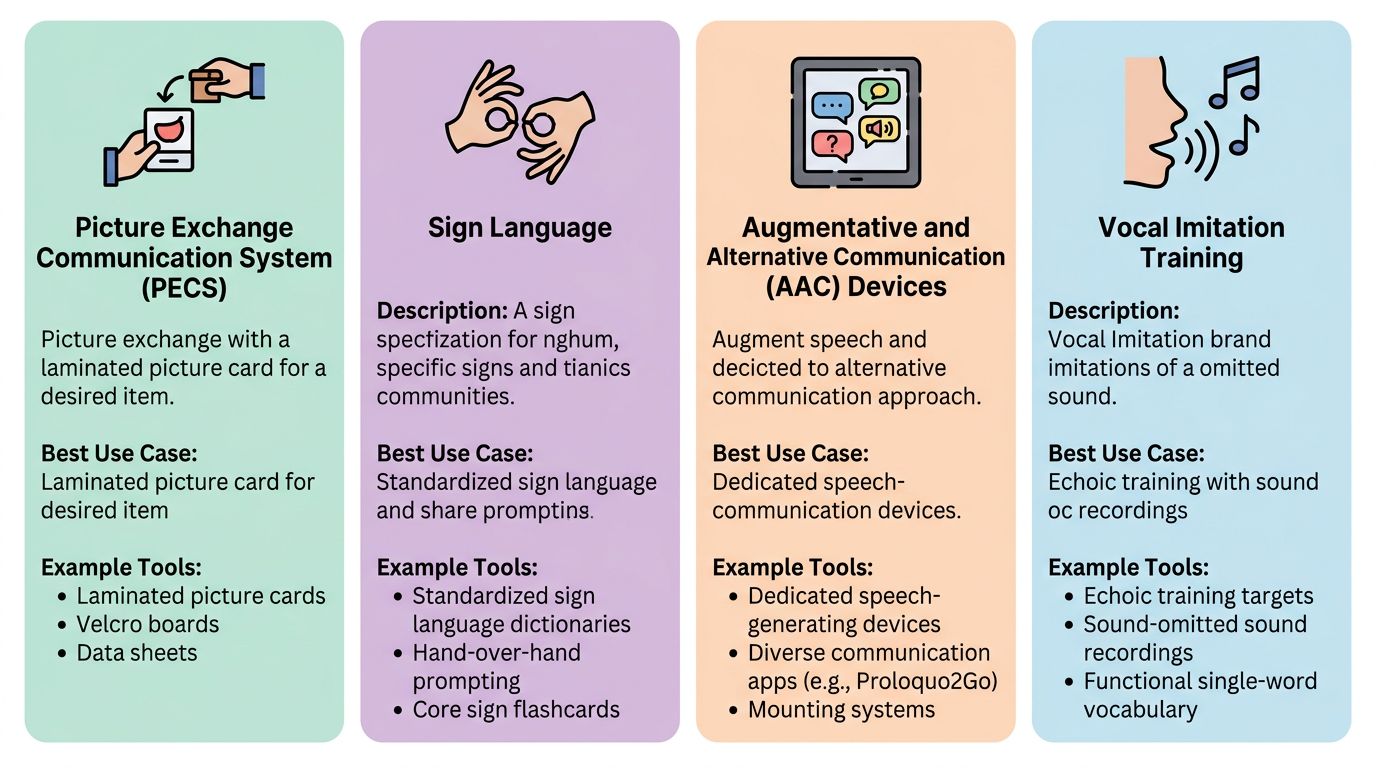
Technology can also be an incredible bridge for many children. Our programs frequently include Augmentative and Alternative Communication (AAC) Devices, a category of tools that runs from dedicated speech-generating tablets to specialized apps that give a child an audible voice with just a tap. This method is backed by research, and the National Institutes of Health has highlighted the effectiveness of AAC systems in providing a robust communication outlet for individuals on the autism spectrum. Heart Core ABA programs incorporate these approaches based on individual learner needs, ensuring that tech-based tools are introduced and taught in a way that promotes real-world interaction. For children who are starting to vocalize, Vocal Imitation Training systematically builds their spoken language by celebrating and reinforcing every sound and word attempt, shaping it into functional, independent speech.
We’ve found that combining these methods almost always yields the best outcomes. A child might use sign language for a quick request while simultaneously learning PECS to expand their vocabulary, with an AAC device as a long-term voice output solution. This integrated framework is a hallmark of our clinical model, where hands-on ABA therapy is centered on helping your child find their voice in all its forms. Our goal is always to cultivate the expressive language skills that let a personality shine through, truly honoring the principle that your child’s heart matters.
Ultimately, building these functional communication skills is the most direct path to enhancing social skills development and overall quality of life. By systematically teaching these abilities, we help autistic children navigate their world with greater ease and confidence, transforming day-to-day interactions from moments of frustration into opportunities for connection. Next, we will explore how we work closely with you, the parents and caregivers, to seamlessly carry these proven communication strategies from our therapy sessions into the heart of your home and daily routines, with personalized coaching and support every step of the way.
How ABA Therapy Builds Functional Communication Skills Step by Step
Beyond the basics of ABA therapy, building functional communication skills is a core goal that follows a step-by-step process. At Heart Core ABA, we see communication as the foundation for real progress, real connection. For many children, especially those who are nonverbal or have limited vocal language, expressing basic wants and needs can be a daily struggle. Our approach doesn’t just teach words; it systematically replaces frustration and challenging behaviors with powerful, teachable moments of connection. By breaking down communication into manageable steps, we help each child find their voice, whether through spoken language, signs, or assistive technology, creating a pathway to greater independence. This process is central to the many benefits of ABA therapy for autism, as it directly improves quality of life for the entire family.
How Functional Communication Training Works
Functional Communication Training (FCT) is an evidence-based ABA intervention designed to replace challenging behaviors with appropriate communicative responses. Rather than simply trying to stop a behavior, we first identify its communicative function—what the child is trying to say. A tantrum might actually mean, “I need a break,” or grabbing a toy could communicate, “I want to play.”
Once we understand the purpose behind the behavior, we select a replacement response that serves the same function but is more effective and socially appropriate. This response is entirely personalized for the child’s success and could be a vocal word, a sign, or a gesture. The process follows a clear sequence:
- A BCBA conducts a functional behavior assessment to determine the “why” behind a specific behavior.
- We identify a communication target, such as saying “help” or using a picture card.
- A therapist and family members systematically prompt the new skill and provide rich reinforcement when the child uses it, while the old, challenging behavior is put on extinction, meaning it no longer results in the desired outcome.
This structured teaching method ensures that communication becomes a more powerful tool than the challenging behavior ever was.
The Role of AAC Tools in Building Communication
For many learners, particularly those who are nonverbal, augmentative and alternative communication tools are a bridge to language. AAC includes any form of communication other than oral speech, and it is deeply integrated into our ABA programs. Common tools we use in therapy sessions include the Picture Exchange Communication System (PECS) and speech-generating devices (SGDs).
PECS teaches a child to initiate communication by handing a picture of a desired item to a communication partner in exchange for that item. It’s a concrete, highly effective way to teach the back-and-forth nature of social interaction. SGDs, ranging from simple button devices to sophisticated tablet applications, give a child an audible voice. A fundamental myth about AAC is that it can hinder the development of spoken language, but research and our clinical experience show the opposite. By reducing frustration and providing a reliable communication model, AAC tools often facilitate the emergence of vocal speech. At Heart Core ABA, our BCBAs assess each child to determine which AAC modality best fits their learning style and needs, ensuring the tool becomes a natural part of their daily life at home, in school, and in the community. These tools are a prime example of how personalized therapy plans harness the benefits of ABA therapy for autism by creating pathways to connection.
Reducing Challenging Behaviors Through Functional Communication
The link between unmet communication needs and challenging behaviors is profoundly clear. When a child lacks a way to express discomfort, anxiety, or a simple desire, their only recourse may be to scream, hit, or run away. This is communication of last resort. The work of FCT directly addresses this by giving the child a more efficient and less energy-consuming alternative. We are not just silencing a behavior; we are honoring the underlying need and teaching a better way to meet it.
Supported by NIH ABA research, this approach is recognized as a highly effective strategy for behavior reduction. When a child learns that a simple sign or icon tap reliably gets their needs met, the motivation to engage in challenging behavior naturally decreases. This shift does more than just resolve immediate conflicts; it opens the door to meaningful social skills development. A child who can calmly request to play, ask for a snack, or indicate they are tired is ready for deeper peer interactions and shared experiences, laying the essential groundwork for building friendships and navigating social situations.
This foundational work in communication paves the way directly for our next focus: social skills development. Once a child has a reliable method for expressing basic needs, they are ready to move on to the nuances of conversation, turn-taking, and shared play, where the heart of social connection truly begins to thrive.
Practical Strategies to Support Functional Communication at Home and in School
Now that we understand what functional communication training is, let’s explore practical strategies to build these essential functional communication skills at home and in school. As your child’s primary communication partner, you play the most important role in helping them express needs, share ideas, and connect with others. At Heart Core ABA, we believe that Hands-on ABA therapy woven into everyday moments creates the most meaningful progress. By embedding support into daily routines, play, and school collaboration, you can help your child develop the expressive and receptive communication abilities they need to thrive.
Practical Home Strategies for Daily Routines
Daily routines offer rich, natural opportunities to strengthen functional language abilities. Morning, mealtime, and bedtime each present predictable moments where you can model, prompt, and reinforce communication without adding extra tasks to your day.
Here are some techniques we recommend:
- Modeling during morning routines: Narrate actions as you help your child get dressed. “Shirt on. Now pants. Find socks.” Pause expectantly to invite your child to fill in a word or gesture. This simple prompting technique encourages day-to-day communication in the home without pressure.
- Mealtime requesting: Place a preferred food item slightly out of reach and wait. When your child reaches or vocalizes, model a simple word or sign like “more” or “cracker.” Provide the item immediately paired with specific praise as reinforcement for their effort.
- Bedtime commenting: Use a familiar picture book to practice commenting. Point to an image and say, “I see a dog. The dog is sleeping.” Then pause and look at your child expectantly. Even a vocalization, point, or eye gaze toward the book counts as a communicative turn.
Structured home based ABA therapy applies these same strategies with data-driven precision. Our BCBAs design personalized routines that fit your family’s schedule, ensuring that skill-building happens consistently and compassionately. The benefits of ABA therapy for autism include this kind of practical, everyday skill growth that leads to real progress, real connection.
Integrating Communication Goals into Playtime
Playtime provides the ideal setting for building social skills development alongside functional communication. When children are engaged with preferred toys and activities, they are more motivated to initiate, request, and comment.
Try these play-based approaches:
- Requesting with preferred toys: Place a favorite toy in a clear container your child cannot open independently. Model the word “open” or “help” and wait. The natural motivation to access the toy creates a powerful teaching moment for expressive communication.
- Commenting during games: During a simple turn-taking game like rolling a ball back and forth, narrate the action: “I roll ball. Your turn.” After several repetitions, pause before your turn and look expectantly, giving your child space to initiate or comment.
- Play-based data collection: Keep a simple notecard nearby during play. Jot down what your child requested, whether they used a word, sign, or gesture, and what prompted the communication. Over a week, patterns emerge that help you adjust your modeling and reinforcement strategies.
These child-led interactions build confidence and spontaneity. Your child learns that communication is powerful and rewarding, laying the groundwork for more complex exchanges with peers and siblings.
Working with School Teams to Support Communication
Generalizing functional communication skills across settings requires close collaboration with your child’s school team. Consistency between home and school reinforces learning and helps your child understand that communication works everywhere, with everyone.
We recommend these collaborative steps:
- Share your child’s communication system: If your child uses an AAC device, picture cards, or specific signs, provide the school team with a simple guide. Include the top five functional requests your child uses at home so staff can honor and reinforce them in the classroom.
- Align behavior and communication plans: Request a meeting to review your child’s IEP or behavior support plan. Share what strategies work at home and ask how the school team addresses the same skills. When home and school use consistent prompting hierarchies and reinforcement, progress accelerates.
- Establish regular check-ins: A quick weekly email or communication log between you and the classroom teacher keeps everyone aligned. Note new words, successful moments, and any challenges so the team can adjust strategies in real time.
Heart Core ABA’s school-based programming extends this collaboration further by embedding BCBA support directly into classroom routines. This ensures that the same evidence-based strategies guiding your child’s expressive and receptive communication at home follow them into the school day.
Consistency across environments is the key to lasting communication growth. When morning routines, playtime, and school interactions all reinforce the same functional language abilities, your child experiences communication as a reliable tool for connection. These strategies lay the foundation for building communication, confidence, and independence in every setting that matters.
Advanced Functional Communication Goals and Milestones in ABA Programs
After children develop the ability to request items and label objects—the groundwork of early communication—we introduce more complex functional communication skills. These skills move beyond basic wants to include sharing thoughts, asking questions, and participating in back-and-forth conversations. This shift helps children connect with others and navigate daily situations with greater confidence.
Advanced functional communication goals in ABA programs target complex verbal behaviors that expand a child’s ability to interact meaningfully. We focus on commenting about surroundings, seeking information by asking questions, and spontaneously initiating conversation with peers and adults. Each goal is carefully individualized, driven by BCBA assessment data and the child’s unique strengths, interests, and current skill level.
Advanced communication milestones we commonly work toward include:
- Using multi-word phrases and sentences to express ideas, preferences, and feelings
- Expressing emotions and internal states, such as “I feel happy,” “I’m tired,” or “That’s too loud”
- Using language for social interaction—turn-taking, staying on topic, and telling simple narratives
- Responding to diverse questions, from “What happened?” to “Why did you do that?”
These milestones are among the most impactful benefits of ABA therapy for autism, because they directly fuel social skills development and authentic connections. We embed learning in everyday moments using incidental teaching, mand training that extends beyond requests, and natural environment teaching. This makes communication practice feel relevant and naturally reinforcing, rather than like a structured drill.
Generalization is a cornerstone of our approach. We ensure every communication skill is practiced across different people, settings, and materials. Through parent coaching and daily practice, families become active partners in reinforcing their child’s functional communication skills. This collaboration helps skills transfer from therapy sessions into mealtimes, playdates, and community outings.
At Heart Core ABA, our in-home model and weekly family updates keep parents closely connected to every achievement. That’s the heart of Real progress, real connection—building communication skills that unlock confidence and independence. Next, we’ll dive into the specific ABA techniques that make these advanced goals achievable in everyday routines.
Frequently Asked Questions About Functional Communication Skills
You might still be wondering how these communication goals take shape in real life.
What are functional communication skills? These are the abilities your child uses to express needs, wants, and feelings in a socially appropriate way. At Heart Core ABA, we look at functional communication skills as the foundation for building meaningful connection and independence.
How does functional communication training help children with autism? Functional communication training (FCT) is a core ABA strategy that replaces challenging behaviors, like tantrums, with acceptable communication. By teaching replacement behaviors, we reduce frustration and support genuine social skills development, which is one of the lasting benefits of aba therapy for autism.
How does Heart Core ABA teach functional communication skills? We start with a BCBA-led assessment to create goals that are personalized for your child’s success. We teach these skills in your home environment to promote generalization, ensuring it is real progress, real connection.
Can functional communication reduce problem behaviors like aggression? Yes. When children learn to communicate what they need instead of acting out, we track consistent progress showing that building communication directly supports emotional regulation and reduces challenging episodes.
How can parents support functional communication development at home? We provide weekly updates and coaching so you can reinforce these new skills consistently. By practicing at home, you empower your child to build communication, confidence, and independence every day.
If you still have questions, we invite you to reach out to our team for a personalized consultation.
Empowering Your Child’s Communication Journey with Heart Core ABA
As a parent, you want your child to build the communication skills they need to thrive. At Heart Core ABA, we provide hands-on, in-home aba therapy designed to develop functional communication skills and support social skills development through personalized plans created by our team of BCBAs and RBTs. Our family-centered approach focuses on real progress, real connection, and building communication, confidence, and independence, and our transparent benefits verification provides clarity as you begin; let’s explore how this works in practice.
Resources
- Get Expert ABA Therapy for Children at Home, School, Center
- Get Expert Home-Based ABA Therapy for Children
- Explore ABA Therapy Programs for Toddlers and Social Skills
- Discover How ABA Therapy Works with Data-Driven Adjustments
- Discover Special Education ABA Trends Including AI and Telehealth
- Discover ABA Integration in Kansas City Special Education Settings
- Discover ABA Techniques in Special Education for Missouri and Kansas
- Explore NIH Medical Research, Clinical Trials, and Health Tools