
Table of Contents
Understanding BCBA vs RBT Roles in ABA Therapy
As you begin ABA therapy, two professionals guide your child’s progress: the BCBA and the RBT. Knowing the key BCBA vs RBT roles helps you understand how therapy works.
Here’s a quick comparison at a glance:
| Feature | BCBA (Analyst) | RBT (Technician) |
|---|---|---|
| Education | Master’s Degree | High School/Equivalent |
| Primary Focus | Assessment & Program Design | Direct Implementation |
This division in BCBA vs RBT scope of practice ensures expert oversight and hands-on support.
The BCBA, or Board Certified Behavior Analyst, holds a master’s degree and BACB certification. They create and supervise your child’s personalized plan.
The RBT implements the plan during 1:1 sessions, following detailed programs. Reflecting behavior analyst vs technician duties, they focus on direct skill-building under close supervision.
Regular BCBA observation keeps therapy on track. In BCBA vs RBT roles, our BCBAs guide RBTs and adjust plans; RBTs never create plans independently. Next, we’ll detail how a BCBA crafts your child’s treatment goals.
1. Role Distinctions Explained
Effective ABA therapy depends on a collaborative team of skilled professionals, and understanding the bcba vs rbt roles is key to appreciating how your child’s program comes together. At Heart Core ABA, our team includes both BCBA (Board Certified Behavior Analyst) and RBT (Registered Behavior Technician) professionals who work closely to deliver care that is personalized for your child’s success.
The BCBA is the clinical leader who designs and oversees the entire therapy program. This professional holds a master’s degree and is certified by the behavior analyst certification board, which ensures rigorous training in behavior assessment and intervention planning. In our in-home therapy sessions, the BCBA conducts initial assessments, develops individualized treatment plans, and monitors progress through ongoing data review and regular team meetings. This role involves making strategic adjustments to goals as your child builds new skills.
The RBT is the technician who brings the therapy plan to life during daily 1:1 sessions. This team member holds a high school diploma and completes 40 hours of specialized training before certification. Under the BCBA’s direct supervision—which must cover at least 5% of therapy hours each month—the RBT delivers hands-on instruction, builds rapport with your child, and collects detailed data on every response. This behavior analyst vs technician duties distinction reflects a carefully designed BCBA vs RBT scope of practice that ensures quality and accountability.
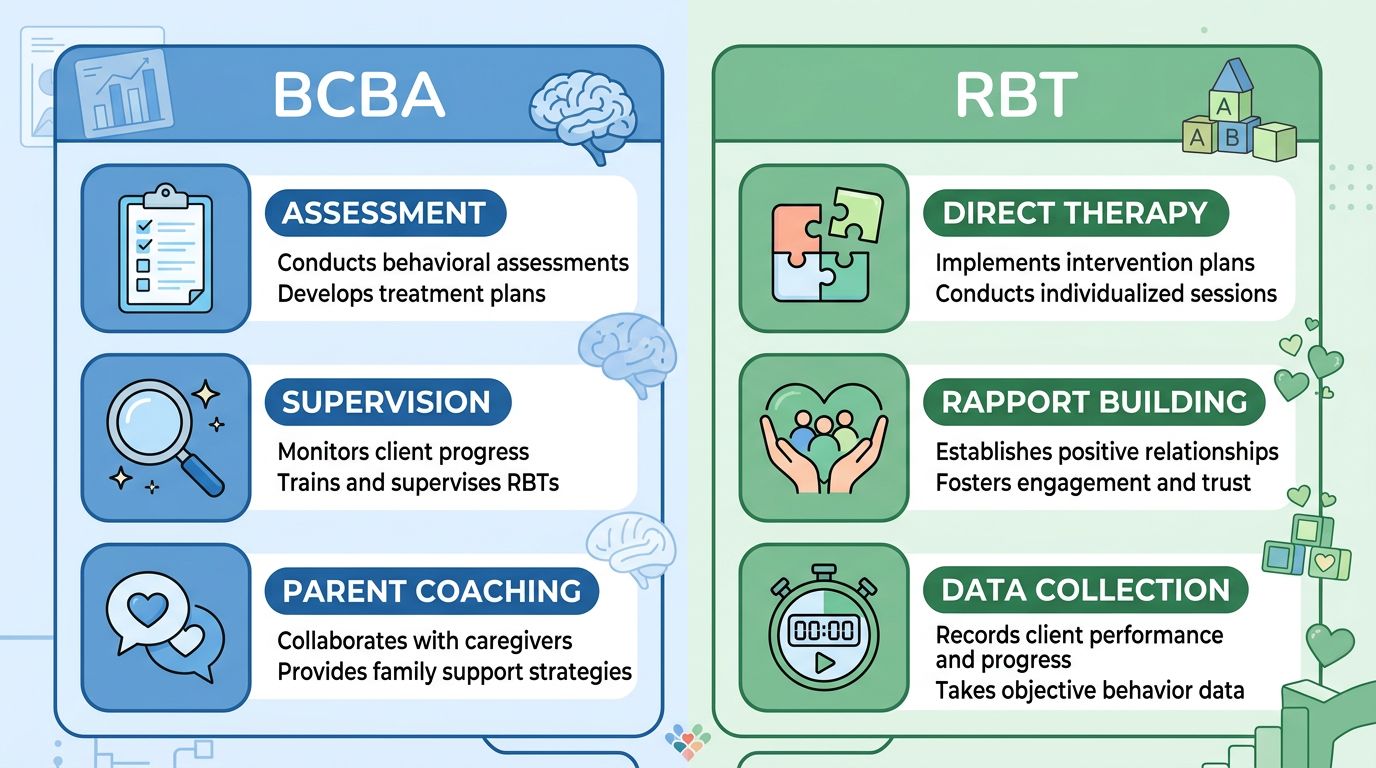
BCBA vs RBT role distinctions in ABA therapy at Heart Core ABA.
2. Qualifications You Can Trust
As we introduced in the overview of ABA therapy, understanding the team behind your child’s care is essential. The difference between BCBA versus RBT roles is fundamental to how we deliver consistent, high-quality therapy. Our team of 42 Board Certified Behavior Analysts oversees every aspect of your child’s plan, while our 54 Registered Behavior Technicians bring those plans to life during daily sessions.
A BCBA holds a master’s degree and has completed 2,000 hours of supervised fieldwork before passing the rigorous national board exam. These professionals design the personalized therapy strategy, conduct assessments, and adjust goals as your child progresses. The scope of practice for a BCBA includes supervision, family training, and ongoing analysis of treatment data. In contrast, the role of an RBT focuses on implementing that plan through hands-on 1:1 sessions under direct BCBA oversight. Behavior analyst versus technician duties are distinct yet collaborative.
- Board Certified Behavior Analysts with master’s-level training and national certification
- Registered Behavior Technicians trained in direct implementation and supervised by BCBAs
- Weekly parent updates from the BCBA overseeing your child’s progress
3. How Supervision Works
When you begin ABA therapy with us, you’ll quickly see how our team collaborates closely to support your child. Understanding bcba vs rbt roles is key to seeing how supervision works: the BCBA designs and oversees your child’s plan, while the RBT provides the direct, hands-on ABA therapy sessions under that guidance.
Supervision is the consistent oversight that connects their work. At Heart Core ABA, your child’s BCBA is responsible for assessing their needs and developing a personalized treatment plan. The RBT then implements this plan with warmth and skill, ensuring each session remains personalized for your child’s success.
4. Daily Responsibilities
Building on the BCBA and RBT introductions, understanding the bcba vs rbt roles in daily practice shows how our team brings consistent, personalized support to your family.
| Daily Responsibilities | BCBA Role | RBT Role |
|---|---|---|
| Plan Development | Designs and adjusts treatment plans | Follows the plan & reports data |
| Direct Delivery | Supervises and models skills | Conducts 1:1 therapy sessions |
| Parent Coaching | Provides weekly expert coaching | Demonstrates strategies live |
5. Progress Through Oversight
At Heart Core ABA, understanding how BCBAs and RBTs work together is the foundation of our approach. Our trained RBTs bring hands-on ABA therapy into your home, but it’s the consistent BCBA oversight that ensures therapy stays targeted and data-driven.
6. Team-Based Care Approach
Understanding the bcba vs rbt roles is key to our team-based care model. At Heart Core ABA, a Board Certified Behavior Analyst (BCBA) designs and oversees your child’s personalized therapy plan, while a Registered Behavior Technician (RBT) implements it directly during in-home sessions.
If you’re looking for ABA therapy near me with a hands-on team, Heart Core ABA provides dedicated BCBA and RBT support.
Building Your Child’s Therapy Team
Understanding BCBA vs RBT roles is the first step in knowing who will support your child. The BCBA designs your child’s personalized treatment plan after an initial in-home assessment, while our RBTs deliver the daily one-on-one therapy.
The BCBA vs RBT scope of practice defines how these roles collaborate. Together, this coordinated team also helps you navigate insurance benefits verification for full transparency. Searching for ABA therapy near me? We are ready to bring personalized care into your home.
Resources
- Find Expert ABA Therapy FAQ and Insurance Guide
- Discover BCBA Certification Requirements and Career Path
- Learn ABA Therapy Diagnosis Requirements and Process
- Find ABA Therapy Insurance Coverage Details and FAQs
- Learn ABA Therapy Eligibility and Intake Process
- Find ABA Therapy Intake Process for Home and School
- Explore 2025 ABA Therapy Trends in Special Education
- Find BACB Certification Information and Award News