
Table of Contents
- Developmental Milestones: What Every Parent Should Know
- The Basics of Child Developmental Milestones
- Exploring Developmental Milestones by Age
- Practical Ways to Track Developmental Milestones
- Developmental Milestones in Autism and ABA Therapy
- Frequently Asked Questions About Milestones
- Empowering Your Child’s Development with Heart Core ABA
Developmental Milestones: What Every Parent Should Know
As parents ourselves, we at HeartCore ABA understand how exciting—and sometimes worrying—it can be to watch your little one grow. Tracking developmental milestones helps spot areas where your child shines and where they might need a little extra support. According to the Centers for Disease Control and Prevention (CDC), these authoritative benchmarks guide what most children do by certain ages, empowering you to act early for the best outcomes.
Here are key categories with examples from birth to 3 years:
Social/Emotional: Smiles at people by 2 months; shows joy or distress by 6 months; plays simple games like pat-a-cake by 18 months; copies adults during toddler developmental milestones around 24-36 months.
Language/Communication: Babbles by 6-9 months; says single words like “mama” by 12 months; follows simple instructions by 24 months.
Cognitive: Explores with hands by 4 months; finds hidden toys by 9 months; sorts shapes by 30 months.
Movement/Physical: Rolls over by 4-6 months; pulls to stand by 9 months; kicks ball and climbs by 36 months.
No babbling by 12 months, limited eye contact, or lack of response to name can signal potential delays, including some autism developmental milestones. For more on signs of autism in toddlers, explore practical guidance from our ABA experts at HeartCore ABA. We can help assess through in-home evaluations.
Hands-on ABA therapy, personalized for your child’s success, supports these growth markers via early intervention for toddlers. If you notice concerns, reach out—we’re here with parent coaching and customized plans to build communication, confidence, and independence.
The Basics of Child Developmental Milestones
Developmental milestones represent the observable skills most children achieve by certain ages, serving as key markers of growth in how they play, learn, speak, act, and move. At Heart Core ABA, we emphasize tracking these child growth markers to support families in celebrating progress and spotting potential needs early. According to the Centers for Disease Control and Prevention (CDC), authoritative U.S. government guidelines highlight four core developmental areas: social/emotional, language/communication, cognitive, and movement/physical development.
Social/Emotional: Children build connections by smiling responsively, imitating expressions, and later showing independence or taking turns in play. Language/Communication: From cooing and responding to their name, kids progress to saying words, following simple instructions, and forming sentences. Cognitive: Exploration evolves into finding hidden objects, sorting shapes, and engaging in imaginative or counting activities. Movement/Physical: Infants hold their heads steady and roll over, advancing to walking, pulling toys, and climbing by toddlerhood.
The following table outlines typical progressions across these areas from infancy to toddlerhood, drawn directly from CDC’s “Learn the Signs. Act Early.” program resources.
| Age Group | Social/Emotional | Language/Communication | Cognitive | Movement/Physical |
|---|---|---|---|---|
| 0-12 Months | Smiles at people; copies expressions | Makes sounds; responds to name | Explores with hands; finds hidden objects | Holds head steady; rolls over |
| 1-2 Years | Shows independence; plays simply with others | Says several words; follows instructions | Sorts shapes; completes sentences | Walks alone; pulls toys |
| 2-3 Years | Copies adults; takes turns | Speaks in sentences; names colors | Engages in fantasy play; understands counting | Climbs; stands on one foot |
Data sourced from CDC milestones checklists. This overview illustrates standard expectations, helping parents visualize typical paths in toddler developmental milestones for ages 1-3 years.
Children develop at their own pace, with normal variations in timing across these developmental milestones. The CDC notes that while most meet these benchmarks, tracking with reliable tools empowers families to act early if concerns arise. Download the free CDC milestones checklists for detailed, age-specific guidance and printable trackers.
Monitoring autism developmental milestones alongside general progress benefits all children, as early insights from Heart Core ABA’s internal experts reveal patterns like delayed social smiles or gestures that warrant attention. These checklists, part of the CDC’s initiative, promote proactive steps without replacing professional advice. We often see families using them to discuss observations with pediatricians, fostering timely support.
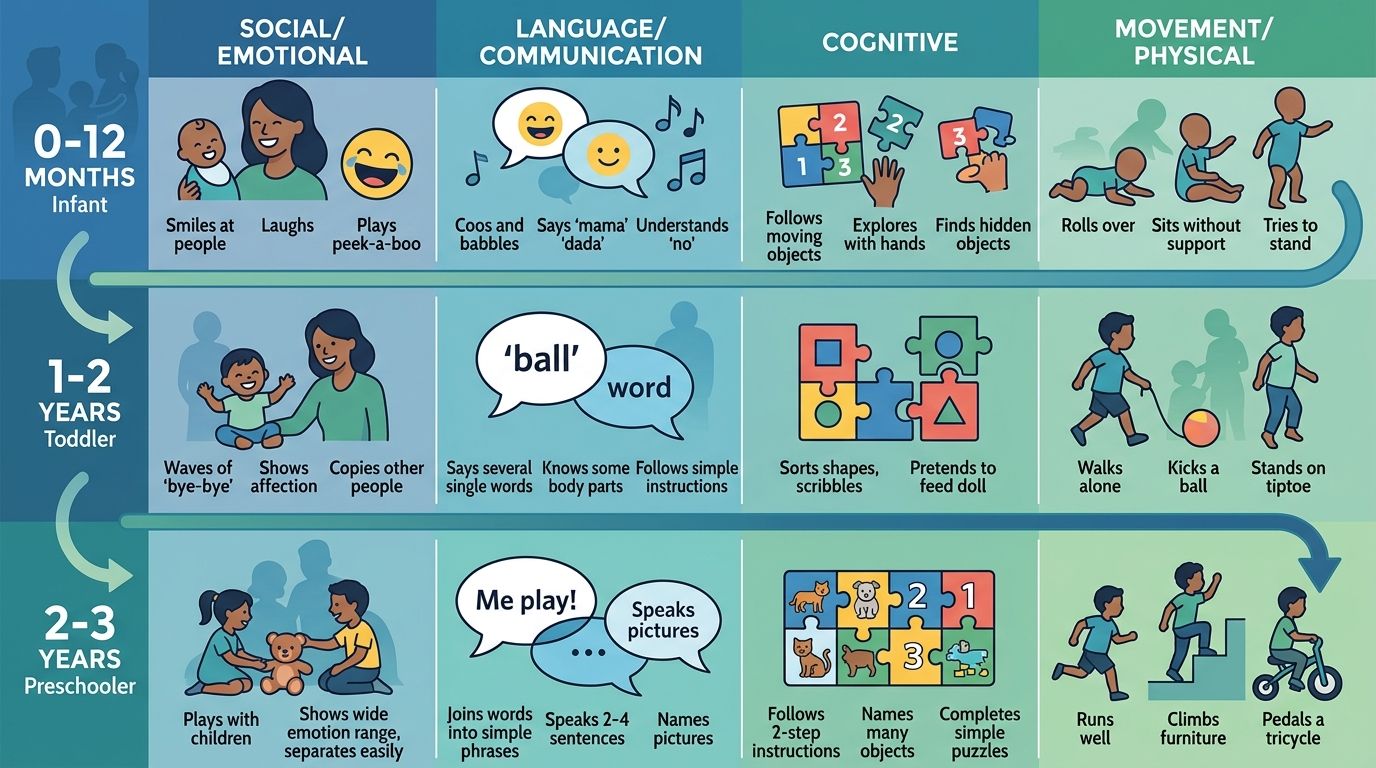
Child developmental milestones infographic by age and key categories
While most children meet these developmental milestones, subtle delays may indicate a need for early intervention. Our hands-on ABA therapy and parent coaching offer personalized support for your child’s success, focusing on building communication, confidence, and independence through in-home assessments and 1:1 sessions tailored to family needs.
Exploring Developmental Milestones by Age
At Heart Core ABA, we understand the joy and wonder of watching toddlers reach developmental milestones. These key achievements in motor, language, and social skills help parents celebrate progress while spotting areas needing support. The CDC developmental milestones provide authoritative benchmarks, like those for 1-year-olds, empowering families to act early for real progress.
Toddler Milestones: 1-3 Years
From ages 1 to 3, toddlers make remarkable strides in toddler developmental milestones. According to the Centers for Disease Control and Prevention (CDC), authoritative government benchmarks show most children achieve these by certain ages, with 75% or more reaching them on time.
Motor skills advance quickly: by 12-18 months, independent walking emerges, building from pulling to stand and cruising along furniture by 1 year. Toddlers soon climb stairs and run by age 2, kicking balls and throwing overhand by 3.
Language milestones include first words around 12-18 months, following waves bye-bye or simple gestures by 1 year. By 2, they use two-word phrases; by 3, sentences form with 200-1,000 words.
Social and emotional growth features responding to their name, social smiling by 6 months, and playing alongside peers by 2-3 years. The CDC notes wariness of strangers by 1 year as normal. We at Heart Core ABA recommend using free tools like the CDC Milestone Tracker app to chart these age-specific milestones.
Tracking Language and Motor Skills Progress
Observing your toddler’s journey from babbling to talking and crawling to confident steps builds confidence in their growth. Heart Core ABA, as an internal provider of expertise, shares parent coaching tips drawn from early observation strategies.
Start with motor skills: note the crawling-to-walking transition by 15 months. Encourage practice through safe play areas, tummy time, and toys that promote pulling up. By 18 months, most walk steadily; track balance by watching if they stand alone briefly by 1 year.
For language progress, listen for babbling turning to first words by 16 months. Respond enthusiastically to gestures like pointing, fostering joint attention. Read daily, name objects, and narrate routines to expand vocabulary.
We recommend weekly notes on achievements, like stacking blocks or imitating sounds. Our parent coaching equips families with evidence-based techniques at home, supporting hands-on ABA therapy for steady gains. Early tracking spots patterns, ensuring personalized for your child’s success.
When Milestones Signal Potential Delays
While every child develops uniquely, certain patterns may indicate potential delays worth discussing with your pediatrician. Centers for Disease Control and Prevention (CDC) guidance highlights screening at 9, 18, and 30 months for concerns like autism developmental milestones.
Watch for no independent walking by 18 months, limited words by 16 months, or minimal eye contact. Other signs include no response to name by 12 months, persistent babbling without gestures, or lack of social smiling. The CDC emphasizes developmental monitoring alongside formal screenings.
If noticed, consult your doctor promptly. Early intervention services, like our Early Intervention for toddlers, can help without implying diagnosis. We focus on building communication and independence through family-centered care.
The table below compares typical timelines with potential delay signs for clarity:
| Milestone | Typical Timeline | Potential Delay Signs |
|---|---|---|
| Walking | By 12-18 months | Not walking by 18 months |
| First Words | 12-18 months | No words by 16 months |
| Social Interaction | By 6 months | Minimal eye contact; no response to name |
This visual reinforces CDC-backed insights, helping parents identify when to seek support. At Heart Core ABA, our hands-on ABA therapy and parent coaching offer personalized for your child’s success. Contact us today for Early Intervention for toddlers and start building communication, confidence, and independence.
Practical Ways to Track Developmental Milestones
Using Checklists and Daily Observations
At Heart Core ABA, we recommend parents start tracking developmental milestones with reliable tools like the CDC milestone checklists. These free resources outline expected skills in areas such as communication, motor development, and social interaction for children from birth to five years. For toddler developmental milestones, parents can note daily observations, like whether a child points to objects by 14 months or uses simple two-word phrases by 24 months.
Logging these moments in a simple journal or app helps spot patterns early. Record specifics, such as the date a child first imitated sounds or stacked blocks, alongside any delays in autism developmental milestones like limited eye contact or not responding to their name. This self-guided approach empowers families to stay proactive.
Home Tracking vs. Professional ABA Monitoring
| Aspect | Home Tracking | ABA Therapy Monitoring |
|---|---|---|
| Frequency | Daily observations | Weekly sessions + data-driven updates |
| Tools | CDC checklists | VB-MAPP, customized plans |
| Support | Self-guided | BCBA oversight, 1:1 RBT sessions |
Home tracking offers flexibility for everyday insights, while professional ABA monitoring provides expert analysis and tailored interventions. This blend maximizes milestone achievements for your child.
Integrating Milestones into ABA Therapy Plans
We at Heart Core ABA begin with a BCBA-led initial assessment to map your child’s current skills against key developmental milestones. Using the VB-MAPP, an industry-standard tool created by Mark Sundberg VB-MAPP, we pinpoint strengths and gaps, especially in autism developmental milestones like verbal behavior and social play.
During hands-on ABA therapy, our trained RBTs collect real-time data in 1:1 sessions held in your child’s natural environment. We track progress on personalized goals, such as imitating actions or following instructions. Personalized for your child’s success, these updates keep therapy aligned with evolving needs.
Parent Coaching for Milestone Achievement
Heart Core ABA delivers weekly parent updates via email or portal, sharing milestone progress reports with clear visuals and next steps. We equip you with hands-on strategies during dedicated coaching sessions. Since your child’s heart matters, we tailor tips to your family’s daily life.
Developmental Milestones in Autism and ABA Therapy
Developmental milestones serve as critical checkpoints in a child’s growth. For children on the autism spectrum, autism developmental milestones often differ. The table below, informed by CDC data and Heart Core ABA expertise, highlights these differences:
| Milestone Area | Typical | Autism Impact |
|---|---|---|
| Social | Joint attention by 9 months | Limited eye contact |
| Communication | Words by 12-18 months | Echolalia or no speech |
| Play | Imaginative play by 2 years | Repetitive behaviors |
Our In-Home ABA Therapy targets these gaps with plans personalized for your child’s success. We deliver RBT-delivered 1:1 ABA sessions in your home, focusing on real progress, real connection. For details on signs of autism in toddlers, explore below.
Frequently Asked Questions About Milestones
What are developmental milestones?
Developmental milestones mark key skills most children achieve by certain ages, such as saying first words around 12 months and walking by 15 months.
What are typical toddler milestones between 12-24 months?
Toddlers often point to objects, imitate actions, and use single words by 16 months, forming two-word phrases by 24 months.
What are red flags for autism developmental milestones?
Signs include no babbling or gesturing by 12-16 months, limited eye contact, or no response to name. For more on signs of autism in toddlers, explore our resources.
Empowering Your Child’s Development with Heart Core ABA
At Heart Core ABA, we empower development by guiding children toward developmental milestones through personalized care.
- BCBA-developed plans with hands-on ABA therapy delivered by RBTs in 1:1 sessions.
- Weekly parent updates to track progress and build communication, confidence, and independence.
Real progress, real connection. Contact us for free insurance verification and explore our in-home assessments and therapy plans.
This article was researched and written with the assistance of AI tools.
Resources
- Identify Early Autism Signs in Toddlers CDC Parent Checklist
- Discover Key Autism Signs Toddlers Name Play Tests
- Spot Autism Signs Non-Talking Toddlers Speech Delays
- Monitor Communication Delays Indicating Autism Toddlers CDC
- Recognize Autism Red Flags 2-Year-Old Toddlers Social
- Track Common Autism Signs Young Toddlers 12-24 Months
- Detect Early Autism Signs 18-Month Toddlers CDC Guide
- Download CDC Developmental Milestone Checklists 2 Months-5 Years
- Explore CDC Developmental Milestones Birth to 5 Years
- Learn Mark Sundberg VB-MAPP Autism Verbal Assessment
- Understand CDC Autism Screening Diagnosis Process Steps
- Track CDC 1-Year-Old Developmental Milestones Guide