
Table of Contents
- Multidisciplinary Autism Care in Missouri: What Families Should Know
- What Is Multidisciplinary Autism Care? Essential Components and Benefits
- The Role of ABA Therapy in a Multidisciplinary Autism Care Team
- Finding Multidisciplinary Autism Care Providers in Missouri
- Trends in Multidisciplinary Autism Care for 2026
- Frequently Asked Questions About Multidisciplinary Autism Care
- Building a Comprehensive Care Plan for Your Child
Multidisciplinary Autism Care in Missouri: What Families Should Know
For families navigating autism support in Missouri, multidisciplinary autism care offers a coordinated path forward. According to the CDC, about 1 in 36 children is identified with autism spectrum disorder, making comprehensive, team-based services essential. This approach brings together a BCBA, RBTs, and collaborations with speech-language pathologists, occupational therapists, and school staff—all working from a single, integrated therapy plan.
A truly effective plan goes beyond one-on-one sessions—it brings together experts from different fields. When you choose Heart Core ABA, your child benefits from a multidisciplinary autism care team that works together to support every area of development. Coordinated care reduces fragmentation and helps children generalize skills across home, school, and community settings. Our approach mirrors an autism multidisciplinary team, ensuring that each therapist and educator shares goals and progress updates, which lowers family stress and creates a more predictable learning experience.
Heart Core ABA’s comprehensive autism treatment is BCBA-led, with consistent RBT matches and parent coaching. We coordinate with schools to align therapy with IEPs, supporting everything from communication to social readiness. Whether you’re in Springfield, St. Louis, Kansas City, or Columbia, our team delivers hands-on ABA therapy for children who learn differently—care that comes straight from the heart. Of course, every child’s progress is unique, and results may vary, but a team-based approach can create a more consistent and supportive environment.
What Is Multidisciplinary Autism Care? Essential Components and Benefits
Because every child learns differently, a one-size-fits-all approach often falls short. That’s why a multidisciplinary team brings together specialists who each address different developmental domains. Multidisciplinary autism care is a coordinated, team-based approach that involves professionals from behavioral, speech, occupational, medical, and mental health fields working together on a shared treatment plan.
The table below outlines the key professionals typically found on such a team and their distinct roles.
| Professional Role | Primary Credential | Focus Area | Contribution to Team |
|---|---|---|---|
| Board Certified Behavior Analyst (BCBA) | BCBA (BACB certification) | Behavioral analysis, skill acquisition, behavior reduction | Designs and supervises ABA therapy, collects data, coordinates with other providers |
| Speech-Language Pathologist (SLP) | CCC-SLP (ASHA certification) | Communication, language, social skills, feeding | Targets speech/language goals, collaborates on communication systems (PECS, AAC) |
| Occupational Therapist (OT) | OTR/L (NBCOT certification) | Sensory processing, fine motor, self-care, daily living | Addresses sensory needs, motor skills, and adaptive behavior to support learning |
| Child Psychologist / Psychiatrist | Ph.D., Psy.D. or M.D. (board certified) | Mental health, diagnosis, medication management | Provides diagnostic assessment, treats co-occurring conditions, may prescribe medication |
| Developmental Pediatrician | M.D. (board certified in developmental-behavioral pediatrics) | Medical evaluation, development, co-occurring conditions | Monitors overall health, coordinates medical aspects of care, refers to specialists |
Each professional on this autism multidisciplinary team holds rigorous credentials and focuses on a core developmental area. A Board Certified Behavior Analyst (BCBA) holds BACB certification ABA therapy, ensuring expertise in behavior analysis. BCBAs design and supervise personalized therapy plans, collect data to track progress, and coordinate closely with other team members to align goals. We at HeartCore ABA rely on our network of BCBAs to deliver hands-on ABA therapy for children who learn differently, creating real progress, real connection for families.
Speech-language pathologists (SLPs) hold the CCC-SLP credential and focus on communication, language, and social skills. They introduce augmentative and alternative communication (AAC) systems when needed, helping children express their needs and connect with others. Occupational therapists (OTs) with the OTR/L credential address sensory processing, fine motor skills, and self-care routines. By integrating sensory strategies into daily activities, they support learning and greater independence. Child psychologists or psychiatrists provide diagnostic evaluations, treat co-occurring mental health conditions, and may prescribe medication when appropriate. Their insights help the team understand the whole child. A developmental pediatrician oversees medical aspects, monitors overall development, and refers to specialists, ensuring that physical health is integrated into the comprehensive autism treatment plan.
When all these experts communicate and align their strategies, children benefit from a holistic, consistent approach. This coordinated model—rooted in multidisciplinary autism care—reduces gaps in care and reinforces skills across home, school, and clinic settings. Research shows that team-based models often lead to better outcomes in communication, social skills, and daily living compared to a single-provider approach, though each child’s progress is unique and can lead to meaningful progress.
Families can explore whether such a team aligns with their child’s needs by contacting a provider like HeartCore ABA. As with any therapeutic approach, results may vary, and we encourage consulting a healthcare professional for diagnosis and treatment.
The Role of ABA Therapy in a Multidisciplinary Autism Care Team
When families in Springfield, MO and across our service areas begin exploring comprehensive autism treatment, understanding how ABA therapy fits into multidisciplinary autism care is essential. At Heart Core ABA, we believe that meaningful progress happens when skilled professionals work together, combining their expertise to support every aspect of a child’s development. Our approach ensures that the hands-on ABA therapy for children who learn differently becomes the foundation for a personalized therapy plan that is coordinated, consistent, and deeply connected to your family’s goals.
Core ABA Interventions Within a Team Framework
Within a multidisciplinary autism care team, the role of ABA therapy extends far beyond isolated skill drills. Our BCBAs design interventions that target communication, social engagement, and daily living skills, then systematically collaborate with other providers to ensure those gains stick. We collect session-by-session data on behaviors and skill acquisition, using ABC observations and mastery criteria to guide every decision. This data becomes a shared language—speech therapists, occupational therapists, and educators can all see what works, what needs adjustment, and how their own efforts can reinforce progress.
Generalization is a cornerstone of effective ABA. A skill learned at the kitchen table must also appear at school, during playdates, and in community outings. We program for generalization from day one by practicing targets across people, materials, and environments, and by inviting other team members to adopt consistent prompting and reinforcement strategies. This coordinated effort turns isolated achievements into real-world abilities.
ABA therapy can be delivered in several settings, each offering unique benefits within a multidisciplinary plan. The table below compares common service settings to help families understand the options available:
| Service Setting | Best For | ABA Integration Level | Typical Frequency |
|---|---|---|---|
| In-Home ABA | Children who need one-on-one, natural environment teaching; families wanting high parent involvement | High – ABA leads, coordinates with other therapies that may also occur in the home | 10–25 hours per week, depending on need |
| Center-Based ABA | Children who benefit from structured environment, multiple peer models, and access to on-site therapies | Moderate – ABA is primary, but other therapies (SLP, OT) may be offered in same building | 15–30 hours per week |
| School-Based ABA | School-age children with IEP goals that align with ABA; collaboration with teachers | Variable – ABA supports educational goals, works within school schedule, may be pull-out or in-classroom | 5–15 hours per week, often during school hours |
| Community Social Skills Groups | Children who need practice with social interaction, peer play, and group dynamics | Low – ABA-trained staff lead groups, but focus is on social skills, not comprehensive ABA | 1–2 hours per week |
Each setting offers distinct advantages depending on a child’s age, goals, and the intensity of support needed. In-home and center-based models allow for deeper ABA integration, while school-based and community group models prioritize skill generalization in natural social contexts. Our team helps you determine which combination aligns best with your child’s journey.
Collaborating with Speech, Occupational, and Physical Therapies
ABA therapy achieves its greatest impact when it is woven into a true autism multidisciplinary team. We regularly coordinate with speech-language pathologists to align communication targets—for example, if a child is working on requesting with an AAC device in speech sessions, our RBTs reinforce those exact same responses during ABA. Similarly, occupational therapists may address sensory regulation or fine motor skills, and our behavior plans can incorporate sensory breaks or handwriting practice as part of natural environment teaching. Physical therapists focus on gross motor development, and we support those goals by embedding movement-based reinforcement that keeps sessions engaging and active.
Our BCBAs lead case coordination meetings where all disciplines share updates, review progress data, and adjust strategies together. This prevents fragmented care and ensures that every provider is working toward the same functional outcomes. Real progress, real connection—when a child finally waves hello, waits their turn, or communicates a need, it is often because multiple therapists reinforced that moment from every angle.
Results may vary, and we encourage families to verify insurance coverage and understand that prior authorization may be required for certain multidisciplinary services. Our team navigates these logistics transparently, so you can focus on what matters: care that comes straight from the heart, delivered by professionals who genuinely collaborate.
Integrating School-Based ABA Services and IEP Alignment
For school-age children, integrating ABA into the educational environment transforms the classroom into an extension of the therapeutic team. We provide school based ABA therapy that supports academic engagement, social interaction with peers, and the behavioral prerequisites for learning—such as sustained attention and transition flexibility—directly within the school day. Our BCBAs align every behavior intervention plan with the goals outlined in a child’s Individualized Education Program, ensuring that school-based ABA reinforces what educators are targeting and what families hope to see at home.
Collaboration with teachers, paraprofessionals, and school psychologists is central to this model. We conduct observations, share data on what motivates the child, and train school staff on consistent prompting and reinforcement strategies. This partnership helps reduce disruptive incidents and builds the skills needed for independent participation in group instruction and social activities.
Consult a healthcare professional for diagnosis and treatment. Information on this site is not a substitute for professional medical advice. Through this coordinated approach, we ensure every aspect of your child’s development is supported—from school to home to community—so that comprehensive autism treatment becomes a seamless web of care rather than a collection of disconnected services.
Finding Multidisciplinary Autism Care Providers in Missouri
Once you understand the value of a coordinated approach, the next step is knowing where to find quality multidisciplinary autism care in Missouri. A comprehensive autism treatment plan often requires a team of specialists working together. We’ll guide you through the process of researching, vetting, and paying for the right integrated services – because every child deserves real progress, real connection.
How to Research and Select a Multidisciplinary Team
Start by searching for providers in your region. Missouri families in St. Louis, Kansas City, Columbia, or Springfield can use state autism directories, local hospital networks, and trusted online listings to identify board-certified professionals. Families in southwestern Missouri, for example, looking for ABA therapy in Springfield can find clinics that coordinate multiple disciplines under one roof.
When you find a potential team, verify their credentials. Look for a Board Certified Behavior Analyst (BCBA) to supervise behavioral interventions, state licensure for speech and occupational therapists, and organizational accreditation such as CARF. A true autism multidisciplinary team should include at least a BCBA, a speech-language pathologist (SLP), and an occupational therapist, with options to add a social worker or dietitian as needed. At Heart Core ABA, our Springfield and Columbia services exemplify this model: our BCBAs design personalized therapy plans while RBTs deliver consistent, one-on-one therapy, and we weave in parent coaching to keep families at the center of care.
To help you evaluate potential providers, we’ve outlined key factors that make a difference in multidisciplinary care.
| Selection Factor | Why It Matters | Questions to Ask |
|---|---|---|
| Provider Experience with Autism | Ensures the team understands evidence-based practices for ASD, including ABA, SLP, and OT | How many years have you served children with autism? Do your staff hold relevant certifications? |
| Range of Services | More services under one roof (or coordinated) means less fragmentation and better communication | Do you offer ABA, speech, occupational therapy, and social skills groups? Do you coordinate with external providers? |
| Team Communication Structure | Regular communication among disciplines ensures goals are aligned and data is shared | How often do team members meet to discuss progress? How are parents included in communication? |
| Insurance and Payment Options | Understanding coverage helps families plan financially and avoid unexpected costs | Do you verify insurance benefits? What major carriers do you work with? Do you offer private pay? |
With those selection factors in mind, let’s look at the specific questions to ask.
Key Questions to Ask Before Committing to a Care Team
To make an informed decision, we recommend asking providers detailed questions about how they work together and support your family. These key areas will help you gauge the depth of collaboration and the quality of care.
- Team Coordination: How do your therapists share progress data? Are multidisciplinary care meetings held regularly?
- Parent Coaching: Does the team provide regular parent training to reinforce skills at home?
- Credentials and Expertise: Do your BCBA, SLP, and OT hold current state licensure and autism-specific certifications?
- Service Integration: How do you align therapy goals across disciplines, and do you coordinate with our child’s school or IEP team?
- Care Plan Customization: Can you describe how you build a personalized therapy plan that combines ABA with speech and occupational goals?
These conversations reveal whether a provider practices true collaborative care. Remember to also ask about day-to-day logistics like session length and staff consistency – consistent RBT matches matter as much as clinical expertise.
Once you’ve found a promising team, the next important step is understanding how to manage insurance and payment for multiple therapies.
Insurance and Payment Considerations for Multidisciplinary Care
Paying for several therapies can feel overwhelming, but with a clear plan you can avoid surprises. Always request a written benefits verification that breaks down coverage for each service: ABA, speech, and occupational therapy separately. Many insurers require prior authorization, so confirm what documentation is needed before beginning treatment. If a recommended therapist is out-of-network, ask about single-case agreements – a direct contract between your insurer and that provider that can reduce out-of-pocket costs.
At Heart Core ABA, we help families navigate insurance verification for private plans and Medicaid, handling the paperwork so you can focus on your child’s progress. While we strive to make therapy accessible, coverage varies widely, and we encourage you to consult a healthcare professional and verify all details with your plan. Information here is not a substitute for professional medical advice. Results may vary, but with the right team and a clear payment plan, your child can receive the comprehensive support they need to build communication, social, and daily living skills – truly care that comes straight from the heart.
By taking these steps, families can feel confident they are choosing a multidisciplinary team that puts real connection before paperwork, empowering their child to reach their full potential.
Trends in Multidisciplinary Autism Care for 2026
As we look ahead to 2026, the landscape of multidisciplinary autism care is set to evolve rapidly, with promising shifts in technology, funding, family involvement, and workforce development. Our team has analyzed current data and emerging directions to help families understand what’s on the horizon.
The table below contrasts the state of care today with predicted trends for 2026.
| Trend Area | Current State (2024–2025) | Predicted Direction (2026) |
|---|---|---|
| Technology Integration | Telehealth for parent training and some therapy sessions; limited data sharing across platforms | More integrated EHR systems, increased use of AI for progress tracking, expanded telehealth access |
| Insurance and Funding Models | Medicaid expansion in many states, private insurance coverage mandates for ABA, but prior authorization hurdles | Greater alignment of coverage for multidisciplinary services, streamlined prior authorization, value-based reimbursement models |
| Parent and Family Involvement | Parent training required for many ABA programs, but often separate from other therapies | Fully integrated parent coaching across disciplines, more family-centered care models |
| Training and Workforce Development | Shortage of BCBAs and other specialists, high turnover among RBTs, limited cross-disciplinary training | More university programs with cross-disciplinary tracks, telehealth supervision models to expand reach, increased use of RBTs in school settings |
These shifts point toward a more connected, family-centered approach to comprehensive autism treatment. Integrated EHR systems will help the autism multidisciplinary team coordinate more effectively, while value-based reimbursement may ease access to comprehensive autism treatment. For families, parent coaching will become a core, coordinated component of the autism multidisciplinary team’s strategy, no longer isolated by discipline. According to the CDC and BACB, the need for integrated autism services is urgent. We believe these advances will make comprehensive autism treatment more accessible.
However, outcomes vary; always consult your healthcare provider for diagnosis and treatment guidance.
The infographic below highlights these changes.
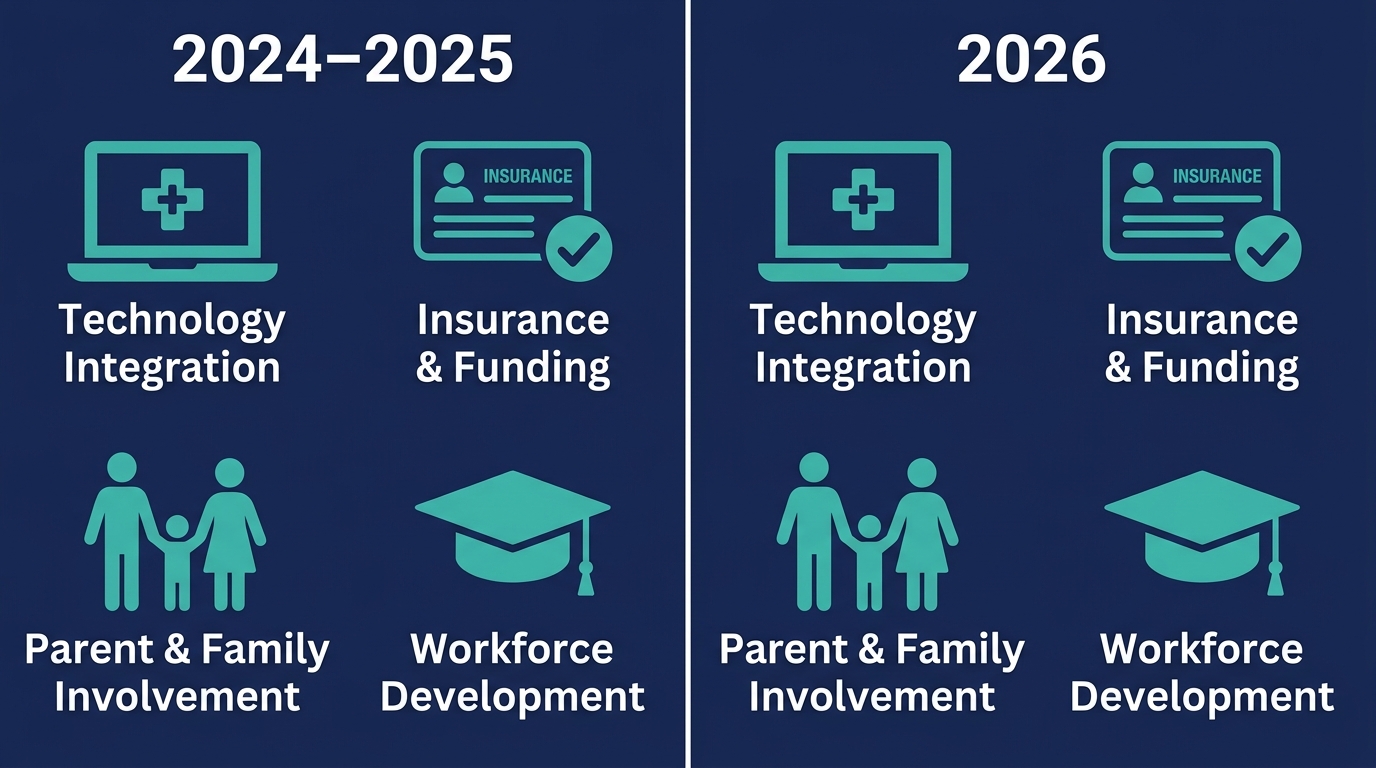
Multidisciplinary autism care trends from 2024–2025 to 2026
At Heart Core ABA, we’re embracing these trends by expanding cross-disciplinary training for our BCBAs and RBTs and staying ahead of insurance innovations. We look forward to providing hands-on ABA therapy for children who learn differently as part of a truly integrated model. In the next section, explore how to choose the right therapy setting for your child.
Frequently Asked Questions About Multidisciplinary Autism Care
Parents often ask us how our team coordinates different therapies to support a child’s development in a multidisciplinary autism care model. Here are answers to common questions about our team-based approach.
What is multidisciplinary autism care and which professionals are involved?
This model brings together different specialists who collaborate on a single treatment plan. For an autism multidisciplinary team, we typically involve a Board Certified Behavior Analyst to oversee ABA therapy, a speech therapist to address communication goals, and an occupational therapist to build daily living and sensory regulation skills.
How do social skills groups fit into a multidisciplinary treatment plan?
Our social skills groups autism are a core part of a balanced plan because they provide structured, data-driven peer practice under the guidance of a BCBA. These groups help children generalize conversation skills and cooperative play learned in 1:1 sessions, making them a natural complement to a comprehensive autism treatment plan.
Our lead BCBA coordinates the full team and includes parent coaching so families can reinforce progress at home and in the community. Results may vary as every child progresses differently, but we believe a coordinated, play-based approach creates the best foundation for real connection.
Building a Comprehensive Care Plan for Your Child
Bringing it all together, a comprehensive care plan is rooted in multidisciplinary autism care. Our autism multidisciplinary team—a BCBA, RBTs, parents, and educators—works under expert supervision to coordinate ABA therapy across settings, integrating speech and occupational therapy as needed.
Each child receives a Personalized therapy plan tailored to their strengths, using play-based methods across settings. Regular reassessment helps us adjust the plan, fostering real progress and real connection. Our comprehensive autism treatment approach is designed to support your child’s growth, though results may vary.