
Table of Contents
- Making Sense of ABA CPT Codes 2026 for Your Family
- What Are the Most Common ABA CPT Codes for 2026?
- ABA Billing Modifiers and Adaptive Behavior Treatment Codes
- How to Read an Insurance Explanation of Benefits (EOB) for ABA
- CPT Codes for BCBA-Led Parent Training Sessions
- Missouri Medicaid vs. Private Insurance: How ABA Billing Codes Differ
- Start Your ABA Therapy Journey with Clear Billing Guidance
Making Sense of ABA CPT Codes 2026 for Your Family
Navigating insurance can feel confusing, but ABA CPT codes 2026 simply standardize how providers bill for applied behavior analysis therapy. These codes are what your insurer uses to process coverage, making it essential to understand the basics.
Adaptive behavior treatment codes describe the specific activities in each therapy session, while aba billing modifiers indicate where and how services take place—like in-home or in a clinic. Knowing these details helps avoid surprises when reviewing your plan’s benefits.
At Heart Core ABA, we take the mystery out of billing with a transparent benefits verification process. Our team of BCBAs and RBTs coordinates with insurers to use the correct codes, so there are no delays in getting started. Personalized for your child’s success, our approach ensures that billing never gets in the way of meaningful progress. You can focus on what truly matters: your child’s growth through our hands-on ABA therapy services. Reach out for a free benefits check—we’re here to help you make sense of the codes for 2026.
What Are the Most Common ABA CPT Codes for 2026?
Navigating the world of therapy billing can feel complex, but understanding the core CPT codes is the first step. For 2026, the most common ABA CPT codes continue to standardize how ABA therapy programs document and bill for services. These codes, part of the adaptive behavior treatment codes set, help ensure families and providers have a clear language for the care being delivered.
Here are the primary codes you will encounter and what they mean for your child’s therapy:
- 97151: This code is for an initial assessment performed by a qualified healthcare professional, like our BCBAs. It’s used to evaluate your child’s needs and create a personalized therapy plan.
- 97153: This is the most commonly used code and represents direct 1-on-1 therapy. It is reported for each 15-minute unit of hands-on ABA therapy an RBT provides, focusing on building communication, play, and daily living skills.
- 97155: Used when a supervising BCBA is modifying the treatment plan. This is not a face-to-face session with the child but time spent reviewing progress, updating programs, and ensuring the intervention is effective.
- 97156: This code covers family or caregiver guidance. When we coach parents on strategies to support progress at home, this code helps document that vital part of the treatment plan.
- 0373T: A key code for our modern approach, this represents adaptive behavior treatment delivered via telehealth. It allows for remote supervision or parent coaching, adding flexibility.
Using correct ABA billing modifiers is just as important as the codes themselves. Modifiers like HO (group services by an RBT) or HM (group services by a BCBA) clarify how services were delivered. The modifier HN specifically indicates a BCBA conducted the service. Proper use of these modifiers in the 2026 CPT code set directly impacts claim approvals.
It is crucial to remember that while the CPT codes for ABA therapy 2026 are standardized by the American Medical Association, reimbursement is not. We always recommend verifying coverage with your insurance provider, as payer policies vary significantly. Even minor annual updates to the aba cpt codes 2026 handbook can influence authorization, so our team stays current to help families through this process.
Now that you know the fundamental codes, the next step is understanding how they come together in the billing process.
ABA Billing Modifiers and Adaptive Behavior Treatment Codes
Understanding aba CPT codes 2026 and their corresponding modifiers is essential for any provider who wants to secure prompt, accurate reimbursement for applied behavior analysis services. The wrong pairing can lead to delays, denials, or compliance headaches that take time away from what matters most: your child’s success. By learning how ABA billing modifiers and adaptive behavior treatment codes work together, our team and your family can stay focused on real progress, real connection, rather than on paperwork.
Modifiers are two-character codes that tell a payer who delivered the service, where it took place, and under what level of supervision. They transform a generic procedure code into a precise snapshot of a clinical interaction. For ABA providers, the most commonly used modifiers include:
- AH – Services provided by a licensed clinical psychologist.
- AM – Services provided by a Board Certified Behavior Analyst (BCBA) or a licensed practitioner operating within their scope.
- HQ – Group services delivered to two or more individuals at the same time.
- HM – Services rendered under the general direction of a qualified professional, which is common when a Registered Behavior Technician (RBT) implements a BCBA-designed plan.
On the code side, three adaptive behavior treatment CPT codes form the backbone of most ABA billing:
- 97151 – Behavior identification assessment. A BCBA conducts a comprehensive evaluation, interviews caregivers, and creates a detailed treatment plan. This code represents the foundational step in building a personalized therapy experience.
- 97153 – Adaptive behavior treatment by protocol, typically delivered one-on-one by an RBT under BCBA supervision. This is the hour-by-hour, hands-on ABA therapy that helps children build communication, confidence, and independence.
- 97155 – Adaptive behavior treatment with protocol modification. A BCBA directly observes the session, adjusts targets, and provides feedback to the RBT and family, ensuring the plan stays aligned with your child’s evolving needs.
The real art of compliant billing is matching the right modifier to the right code. A session rendered by an RBT (modifier HM) without concurrent BCBA oversight should rarely carry modifier AM. Likewise, a 97153 session delivered in a social skills group would require modifier HQ, but only if the payer’s policy permits group billing under that code. When claims combine these elements incorrectly, payers may flag the charge as inconsistent with the practitioner’s credential level — exactly the kind of error that triggers an audit.
National guidance reinforces these practices. According to the Centers for Medicare & Medicaid Services (CMS), CMS Medicare Medicaid coverage policies for ABA services emphasize medical necessity documentation and correct use of HCPCS modifiers. The Behavior Analyst Certification Board (BACB) builds on this foundation with an ethics code that requires certificants to bill only for services delivered within their scope of competence — a standard that directly influences when modifiers such as AH or AM can be applied. Together, these authorities create a framework that protects families and funds.
Even within this framework, every commercial plan and state Medicaid program can add its own twists. Some payers require prior authorization for assessments under 97151, while others limit the number of 97153 hours per week. We have found that taking a proactive, transparent approach — verifying benefits before treatment begins and double-checking payer-specific modifier rules — can help maximize appropriate reimbursement and keep the focus on therapy rather than on claims.
How to Read an Insurance Explanation of Benefits (EOB) for ABA
After our team helps you verify your insurance benefits, you will receive an Explanation of Benefits (EOB) from your insurance company after each billing cycle. This document is not a bill but a summary of how your plan processed the claim for services. For families receiving ABA therapy in Missouri, understanding these details is a key part of managing care costs with confidence.
Start by reviewing the basic header information, which includes the patient’s name, the provider’s name, and the specific dates services were rendered. Next, look at the CPT Code column. These codes represent the exact services your child received; for example, code 97153 denotes direct 1:1 therapy. You can verify they align with the most recent guidelines for aba cpt codes 2026. You might also see notes for aba billing modifiers that provide additional context about the session, such as whether it was delivered via telehealth, alongside the standard adaptive behavior treatment codes for skill-building programs.
The financial breakdown follows a predictable pattern. The Billed Amount is the provider’s standard charge, while the Allowed Amount is the discounted rate your insurer has pre-negotiated with in-network providers. It is normal to see a difference here, as Heart Core ABA works from these negotiated rates to keep costs transparent for your family. The Insurance Paid column shows what the plan covered. The remaining balance in the Patient Responsibility column reflects your share, which can include your copay, any unmet annual deductible, or a coinsurance percentage.
If something looks incorrect, taking prompt action protects your budget. We recommend these steps:
- Compare the codes and service dates on the EOB against your personal records of session attendance.
- Contact our billing team immediately if you notice a discrepancy, so we can verify the claim with your insurer.
- If the error persists after our review, call the member services number on the back of your insurance card to initiate a formal review.
- Keep both digital and physical copies of every EOB for at least one year for your records.
We believe that clear communication builds real progress, real connection. Our team provides transparent benefits verification so you feel secure in your child’s financial plan.
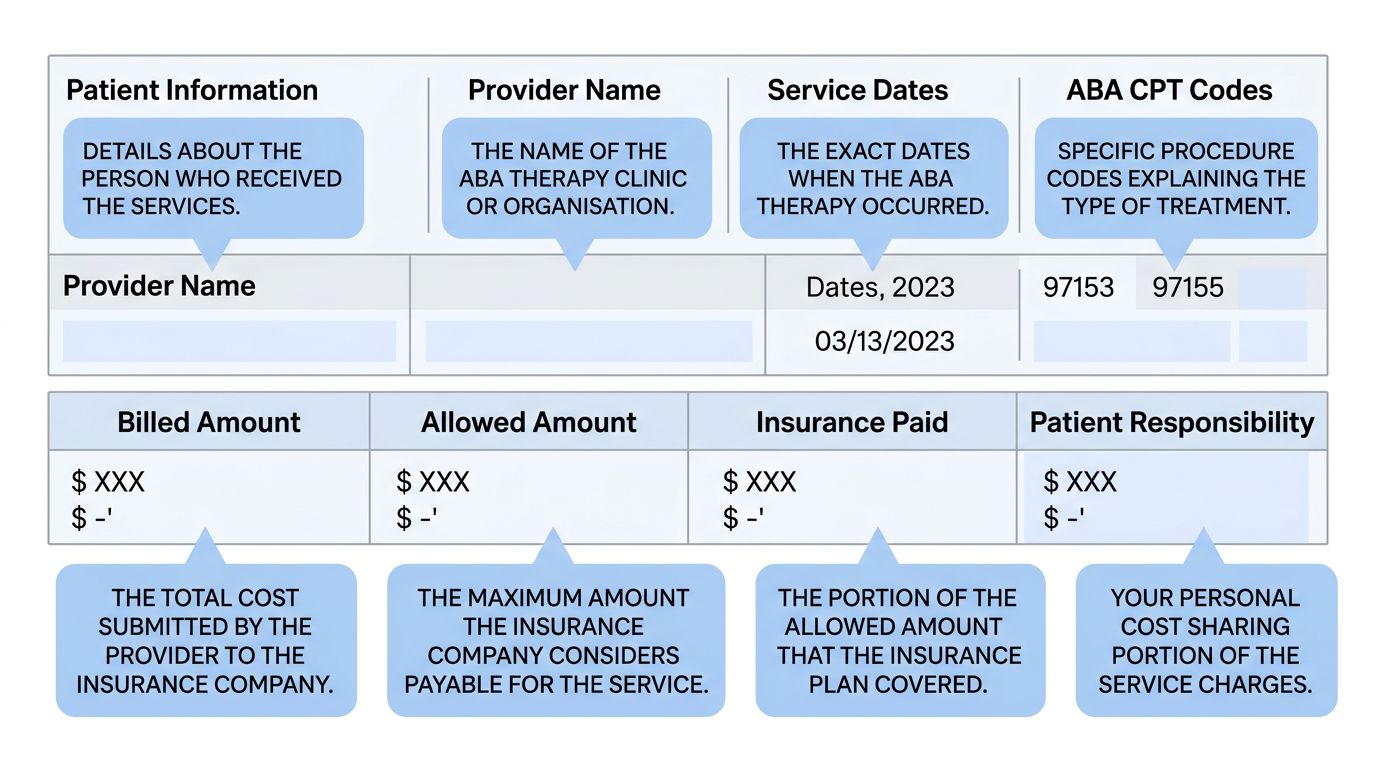
Simplified guide to reading an ABA therapy EOB
Mastering your EOB gives you the power to track your investment in your child’s growth. When you have a clear picture of allowed amounts and patient responsibility, you can budget without surprises. Building skills, confidence, and independence starts with this level of understanding, and we are here to answer your questions every step of the way.
CPT Codes for BCBA-Led Parent Training Sessions
Staying current with aba cpt codes 2026 helps us at Heart Core ABA bill parent coaching sessions transparently and accurately. After exploring the benefits of parent training, we’re now looking at the specific CPT codes our BCBAs use to document these valuable sessions — codes that the Behavior Analyst Certification Board (BACB) recognizes as part of certified behavior analysts’ scope.
The adaptive behavior treatment codes most relevant to BCBA-led parent training fall into three primary categories:
- CPT 97151 — This code covers comprehensive assessment and treatment planning. Our BCBA uses it when evaluating a child’s skill profile and designing the initial parent training goals during an in-home visit.
- CPT 97155 — This code is used for protocol modification; in parent training, it applies when the BCBA adjusts the coaching plan based on the family’s progress or new behavioral data.
- CPT 97156 — The core family adaptive behavior treatment guidance code, billed for one-on-one parent training with the BCBA, such as teaching communication strategies or managing challenging behaviors at home.
- For group settings, CPT 97157 covers group family/caregiver adaptive behavior treatment, but most of our parent coaching is delivered individually under CPT 97156.
Only BCBAs — not Registered Behavior Technicians (RBTs) — are qualified to deliver services under these codes. The BACB’s certification standards ensure that a BCBA’s training encompasses the assessment, plan modification, and family guidance these codes represent. At Heart Core ABA, our team of 42 BCBAs brings that clinical expertise into every in-home parent training session, always aligning session documentation with the code that matches the work performed.
When billing parent training, adding the correct aba billing modifiers is essential. The HA modifier, for example, is typically required on CPT 97156 claims to indicate the service is a family/caregiver treatment. Because 2026 ABA CPT codes and modifiers can shift, we encourage providers to verify the latest CPT manual and payer guidelines before submitting claims. For more guidance on certification and code updates, we recommend these behavior analysis resources.
Missouri Medicaid vs. Private Insurance: How ABA Billing Codes Differ
With aba cpt codes 2026 updates taking effect, understanding how billing differs between payers is critical. We know the process can feel overwhelming, so we are breaking it down for you.
In your MO HealthNet plan, you will often see HCPCS codes used for adaptive behavior treatment. By contrast, private plans typically rely on CPT codes like 97153 and 97155. These code sets represent similar services, but private plan billing standards often adopt the latest American Medical Association revisions faster than public payer codes. This means your claims require careful attention to the specific set your plan follows. When we verify benefits, we check state-specific manuals and private plan medical policies so you avoid denials and delays, and we send required documentation to your clinician and billing team before submitting claims on your behalf with clear timelines and next steps for your family today.
Next, aba billing modifiers add another layer. For a child in a group setting, Missouri Medicaid frequently requires the HQ modifier, while the HA modifier signals treatment for a child or adolescent. Private insurers may use these aba billing modifiers differently or request additional documentation to support medical necessity. We also remind you that Missouri Medicaid often limits daily units and mandates prior authorization, whereas private plans set their own adaptive behavior treatment codes requirements through internal medical policies.
To navigate the 2026 changes, services must be delivered by a licensed behavior analyst certification holder who stays current with these evolving standards. As your partner in Hands-on ABA therapy, we believe Your child’s heart matters. Our team helps you verify your specific plan codes and manage authorization steps so you can focus on what matters most: Real progress, real connection at home. Our benefits team is ready to simplify this for you.
Start Your ABA Therapy Journey with Clear Billing Guidance
We know that starting ABA therapy brings many questions, and understanding the financial side shouldn’t be a source of stress. That’s why we begin every family relationship with clear, transparent billing guidance. As we help you navigate the process, staying current with ABA CPT codes 2026 is a core part of how our team ensures claims are handled accurately from day one.
Before therapy begins, we verify your insurance benefits so you know exactly what to expect. Our team explains how ABA billing modifiers and adaptive behavior treatment codes apply to your plan, removing the guesswork. You focus on your child’s progress while we manage the paperwork and claims behind the scenes.
Real progress, real connection starts with feeling supported in every aspect of care—including billing. Reach out today, and let’s walk through your coverage together so there are no surprises.
Resources
- Explore Comprehensive ABA Therapy Programs for Children
- Discover Personalized ABA Therapy in Missouri
- Explore Personalized ABA Therapy Services for Children
- Discover ABA Therapy for Children with Parent Coaching
- Enhance Child Development with ABA Therapy
- Meet the HeartCore ABA Therapy Team
- Explore ABA Therapy Cost and Insurance Coverage
- Access CMS Medicare and Medicaid Coverage Resources
- Access Behavior Analysis Resources and Continuing Education
- Explore BACB Behavior Analyst Certification and Resources
- Access Missouri Government Services and Public Programs